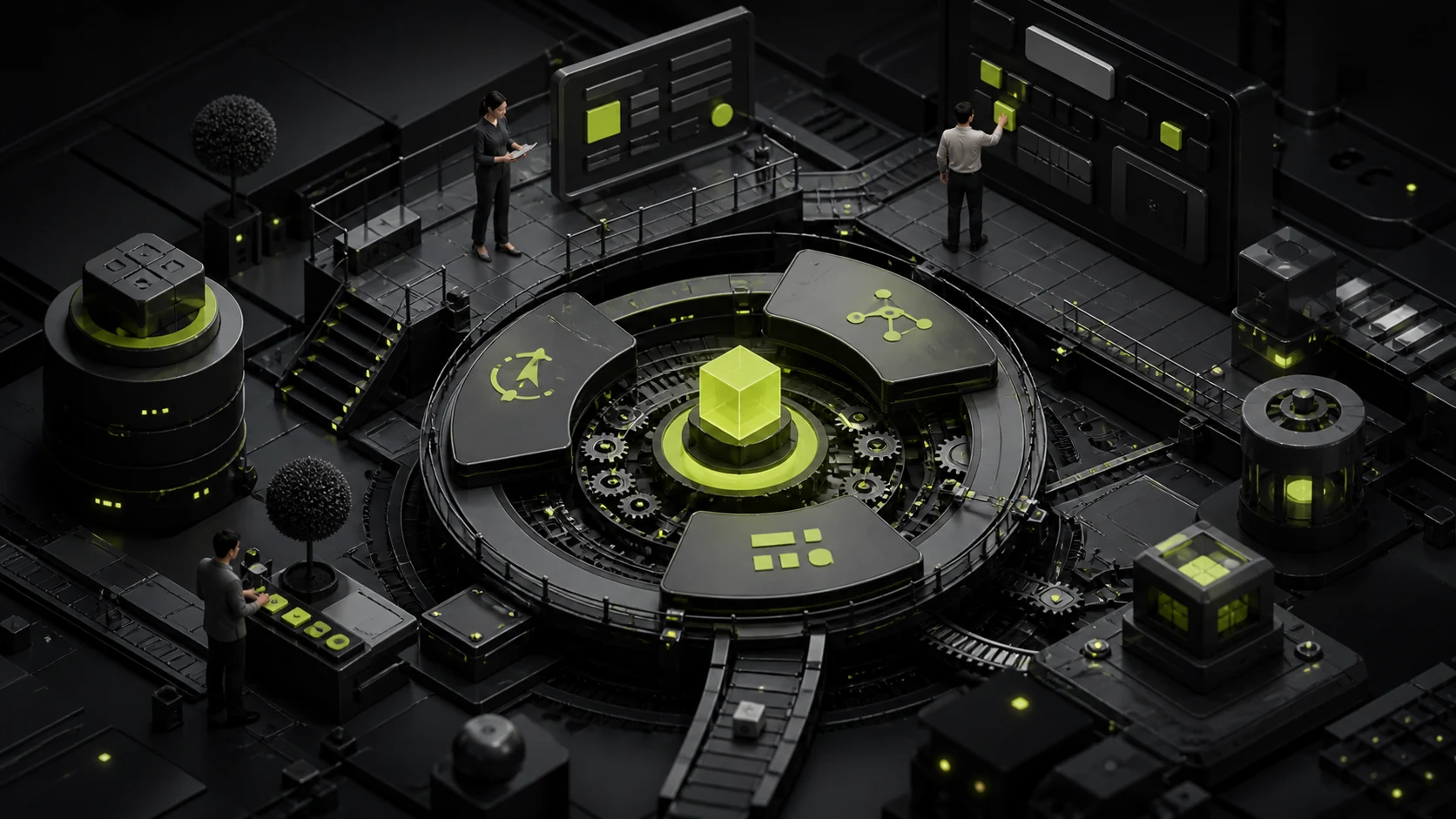
The Human-in-the-Loop is not "AI finishes, humans take another look": True human-machine collaboration should place humans at the key judgment point
If AI requires people to recheck each piece of data it processes, the efficiency improvement will be limited. If completely unsupervised, high-risk errors may be magnified in batches. The core of the Human-in-the-Loop is to identify which decisions must be made by humans, which repetitive tasks can be completed automatically, and when exceptions escalate.
01 First draw the risk map, and then determine the manual nodes
In a workflow, the risks of generating drafts, classifying labels, sending contracts, and deleting data vary greatly. Manual review should not be evenly distributed but should focus on irreversible, high-amount, external influence and highly uncertain nodes.
NIST AI RMF emphasizes governance, measurement and management of risks. UX can transform these risks into different approval and supervision models.
02 Low-risk high-frequency tasks are suitable for sampling rather than item-by-item review
For instance, when AI labels internal work orders, if the historical accuracy rate is stable, it can automatically handle the majority and only hand over low-confidence or abnormal samples to humans.
Human resources should be concentrated on the parts where errors are most likely to occur and where the cost of errors is the highest, rather than becoming a formal stamp at every step.

03 The review interface should enable users to quickly see "Why did the AI make such a judgment?"
If only one conclusion and "approve/reject" are displayed, the reviewer will have to re-examine the entire context. It can simultaneously display key evidence, sources, model extraction fields and outliers.
The task of humans should be to make judgments, not to redo information collection for AI.
04 Abnormal upgrades must have clear trigger conditions
When the amount exceeds the threshold, there is a source conflict, the user's intention is unclear, or the model output triggers a sensitive category, the system can automatically enter the manual queue.
These rules should be configurable, auditable, and let the operators know "why I need to handle this one".
05 Do not allow the AI and humans to continue executing simultaneously after the manual takeover
In customer service scenarios, if a human has already taken over and the AI still automatically sends messages, it will cause serious conflicts. The takeover status should clearly define the responsible entity for the switch and stop the relevant automatic actions.
When it is necessary to return the AI again, there should also be explicit operations to make the workflow status understandable.

06 Manual feedback should form usable data rather than merely recording the approval rate
The reasons for rejection can be structured as "factual errors, format errors, permission issues, inapplicable policies", etc., to assist the product team in diagnosis.
Both Microsoft HAX and Google PAIR emphasize the value of granular feedback. Simple likes or dislikes often lack sufficient information for complex enterprise tasks.
07 Supervisors can also get tired, and the automatic consent in the review interface needs to be reduced
If all 500 consecutive results are correct, exception 501 can be easily approved. "automation bias" can be reduced through risk ranking, anomaly highlighting, batch review restrictions, and regular calibration.
Human presence in the environment does not necessarily mean safety; human attention also needs to be designed.
08 The boundaries of responsibility must be clear at the product and process levels
Who is responsible for the final outgoing email? Who can approve payments exceeding 100,000 yuan? Is AI output merely a suggestion? These cannot be determined solely by UI copywriting; they need to be defined together with organizational policies and authorities.
A good Human-in-the-Loop is not about adding a Review button to all AI pages, but rather about establishing a set of working systems that define what each person and machine are responsible for.

09 Manual queues require priorities and SLAs, rather than an infinite list
High-risk anomalies, customer requests that are about to time out, and low-confidence ordinary tasks should not be mixed together. They can be sorted by risk, business value and waiting time.
If manual review becomes a bottleneck, users should see the expected waiting or alternative path instead of the task always "waiting for manual".
10 The review work should support batch and template-based processing
Low-risk anomalies of the same type can be approved in batches and the reasons can be filled in in batches. For high-risk cases, they can be further explored item by item.
The goal of Human-in-the-Loop still includes efficiency. The manual interface should not be made into a new bottleneck that is slower than the original process.
11 Regularly calibrate the division of labor between humans and AI
As model capabilities, data and policies change, steps that previously required manual review may be automated, and new problems may also arise in low-risk scenarios in the past.
The team should continuously adjust the threshold based on erroneous data and business results, rather than configuring it once and keeping it unchanged permanently.
Frequently Asked Questions
Does the Human-in-the-Loop require manual review for all AI outputs?
No. Manual efforts should be concentrated on high-risk, highly uncertain and abnormal nodes.
How to supervise low-risk tasks?
Sampling, setting abnormal thresholds and continuous quality monitoring can be carried out instead of checking each item one by one.
Does the reviewer need to see the model's thinking process?
Usually, complete internal reasoning is not necessary; instead, evidence, sources, key inputs and verifiable explanations are required.
Can AI continue to assist after human takeover?
Suggestions can be provided, but the automatic enforcement power should be clearly controlled based on the takeover status to avoid simultaneous actions by both parties.
Why is it necessary to record the reasons for rejection?
It can generate high-quality feedback data to help identify issues related to models, data, processes or permissions.
| Related Service | Learn More |
|---|---|
| UI/UX Design Services | View Service Details |
| Project Consultation | Contact JVDS Design Studio |
| Design and Website Development Articles | Read More Related Articles |
 Link copied