
How to Design a Pet Services App: Separate Pet Profiles from Local Services
A pet product is not simply a human lifestyle app with cat and dog icons. One user may have three pets, each with a different age, vaccination history, diet, health condition, and service record. Grooming, telehealth, boarding, community, and commerce also involve tasks with very different frequencies. If the information architecture is divided only by business department, users must repeatedly clarify which pet they are acting for and what they need.
A pet product is not simply a human lifestyle app with cat and dog icons. One user may have three pets, each with a different age, vaccination history, diet, health condition, and service record. Grooming, telehealth, boarding, community, and commerce also involve tasks with very different frequencies. If the information architecture is divided only by business department, users must repeatedly clarify which pet they are acting for and what they need.
01 The Primary Object Is Not the User, but the Owner-Pet Pair
The account belongs to the owner, but much of the data, reminders, and services belong to a specific pet. The home screen, orders, health records, and content recommendations all need to recognize the active pet context while still supporting cross-pet views.
Multi-pet households expose structural problems quickly. Can one order include two pets? Can family members jointly manage profiles? What happens to historical records when a pet is adopted by another household or transferred? These issues cannot be solved later by simply adding a few fields.
| Object | Typical Information | Boundaries to Address |
|---|---|---|
| Owner account | Contact details, address, payment, membership | Family members, privacy, marketing preferences |
| Pet profile | Species, breed, birth date, sex, weight | Switching pets, transfer, profile status after death |
| Health record | Vaccinations, parasite prevention, medical history, allergies, medication | Source reliability, attachments, dates, and providers |
| Service order | Grooming, boarding, consultation, training | Pet receiving service, fulfillment time, special requirements |
| Content and community | Posts, follows, saves, topics | How owner and pet identities are displayed |

02 Prioritize Features by Frequency and Urgency, Not Commercial Value
The platform may want users to buy products, but users may open the app more often to check a vaccination date, book grooming, contact a boarding provider, or find a nearby hospital. If promotions dominate the home screen, the product will quickly become an infrequently used store.
Give frequent, imminent, and urgent tasks the shortest paths: upcoming vaccinations, active orders, appointments awaiting confirmation, medication reminders, and emergency contacts. Lower-frequency knowledge, membership, and shopping features can appear according to the pet's life stage and actual needs.
| Task Type | Examples | Home-Screen Priority |
|---|---|---|
| Emergency tasks | Emergency clinic call, lost pet, alarming symptoms | Highest; fast access without forcing deep-page login |
| Upcoming tasks | Vaccination, parasite prevention, follow-up, order time | Appear dynamically according to date |
| Active tasks | Boarding status, consultation reply, delivery | Remain visible until complete |
| Recurring tasks | Staple food purchase, grooming, training | Remind based on history without excessive notifications |
| Exploration tasks | Community, knowledge, new services | Offer personalized entry points beyond core tasks |
03 Distinguish Owner-Entered and Provider-Verified Health Records
Owners can record weight, diet, and symptoms, but those entries are not medical diagnoses. The product should clearly label the source, record date, and whether a provider has verified the information. Uploading a photo of a medical record also does not create a structured health record; users should be able to retain the original while extracting key fields.
If the platform connects users with hospitals or veterinarians, it must clarify the boundaries among online guidance, formal diagnosis and treatment, and in-person care. In emergencies, do not delay users with a long questionnaire. Provide immediate contact options and nearby services.
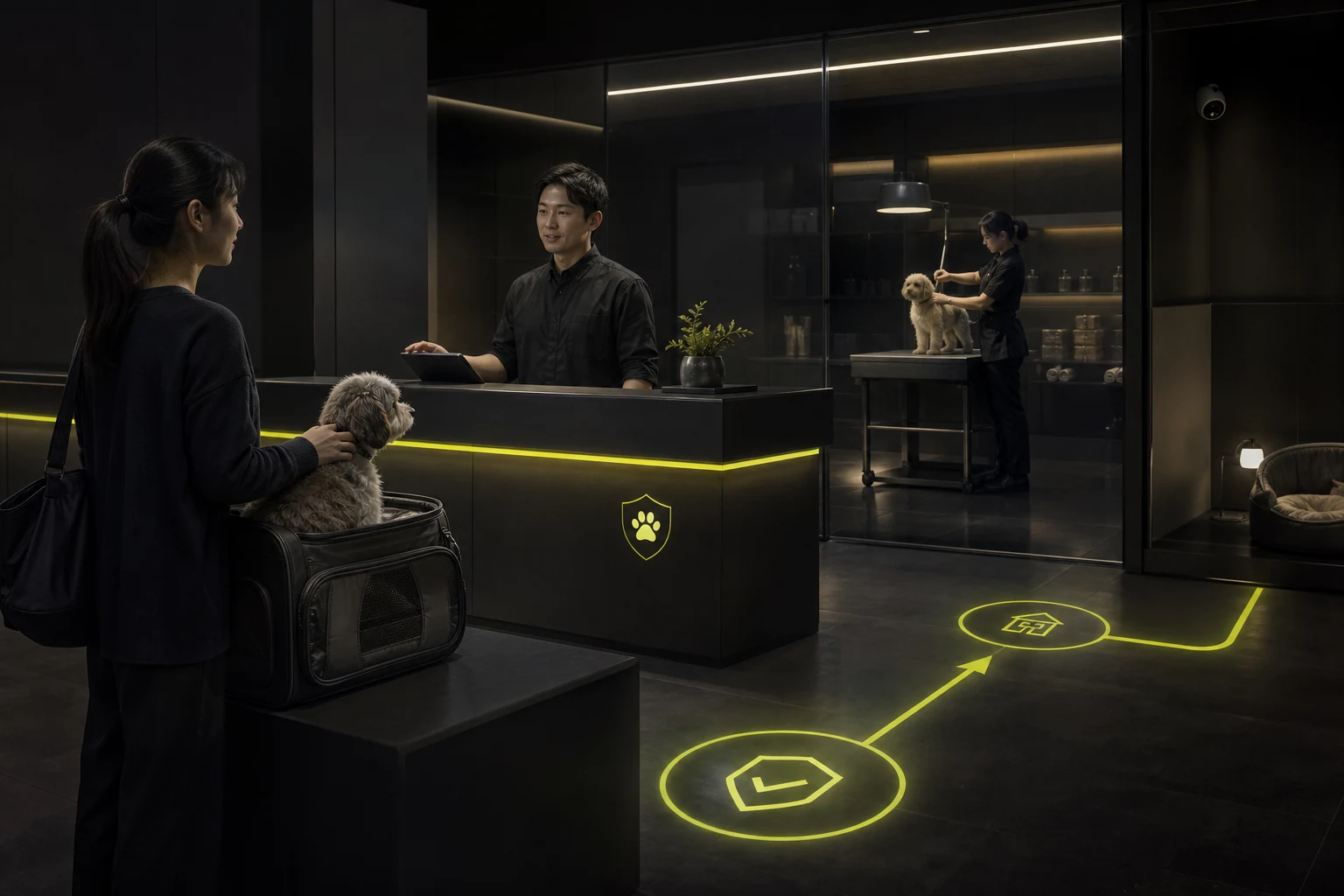
04 Local Services Must Answer Whether Owners Can Safely Entrust Their Pets
Pet grooming, boarding, in-home feeding, and training all require a high degree of trust. Ranking cannot rely only on distance and discounts. It should show credentials, restrictions on animals served, facilities, staff, emergency plans, real appointment availability, and cancellation rules.
Reviews also need structure. Separating friendliness from facility hygiene, professional handling, punctuality, and stress management helps the next user make a better decision. If a dispute occurs, the platform must be able to reconstruct booking requirements, communications, service records, and handoff confirmation.
Conversion on a pet services platform comes less from additional discounts than from whether users feel safe entrusting their pets to a provider.
05 Do Not Turn a Pet's Community Identity into Performance Pressure
A community can help users exchange experience, document growth, and meet nearby pet owners, but it can also spread incorrect medical advice, breeding transactions, false lost-pet information, and harmful content. The product needs explicit content types and moderation rules.
Health-related posts can include a reminder that shared experience is not a substitute for veterinary care. Lost-pet notices need updated times, locations, and contact details. Local events should state eligibility, vaccination requirements, and liability boundaries. Harm to animals, dangerous challenges, and prohibited trading should have clear reporting paths.

06 Better Bottom Navigation Does Not Necessarily Need Five Channels
For an all-in-one product, Home, Services, Records, Community, and Account may be a reasonable starting point, but not a fixed answer. If health is the core business, Records can be a primary entry point. If local fulfillment is central, Services should support search, booking, and orders. If content is only supportive, Community does not need equal top-level prominence.
Navigation should reflect users' most common tasks and the business model, not the five icons competitors happen to use. An MVP requires particular discipline: close the loop on one or two high-value scenarios before expanding into commerce and social features.
| Product Positioning | Recommended Primary Entry Points | Features to Defer |
|---|---|---|
| Health management | Pet profile, reminders, consultations/hospitals | General community, complex commerce |
| Local services platform | Search, booking, orders, pet requirements | Long-term health data analysis |
| Content community | Following, publishing, topics, local events | Asset-heavy fulfillment services |
| Integrated membership platform | Task-based home, services, records, benefits | Launching every business line at once |
07 Measure Retention Across the Pet Lifecycle
Pet-care needs change with age and health. New owners focus on vaccinations, parasite prevention, and supplies. Adult-pet care emphasizes recurring services. Senior pets and chronic conditions require continuous records and follow-up visits. Overall daily active users alone will not reveal whether the product is genuinely useful at critical stages.
Teams can track profile completion, reminder completion, appointment attendance, repeat-purchase intervals, multi-pet household usage, service complaints, and reports of high-risk advice. Community engagement is only one part of the picture and should not be the sole success metric for an integrated pet product.
Frequently Asked Questions
Should a pet app require users to create a profile first?
Not at every entry point. Users can browse content and nearby services first. When health reminders, booking, consultations, or personalization require a profile, build it progressively with the minimum necessary fields.
Should users be able to edit pet medical records themselves?
Owners can add information, but they should not directly overwrite original provider-generated records. A better approach preserves the original, allows supplemental notes, and displays the source and edit history.
What should an all-in-one pet app MVP build first?
Choose one core scenario that can form a complete loop, such as profiles plus health reminders, or local-service search plus booking and orders. Commerce, community, and membership can follow after the product establishes a reliable core usage frequency.
| Service | View |
|---|---|
| UI/UX Design Services | View service details |
| Project Consultation | Contact JVDS |
| Design and Web Development Articles | Read more related articles |
 Link copied