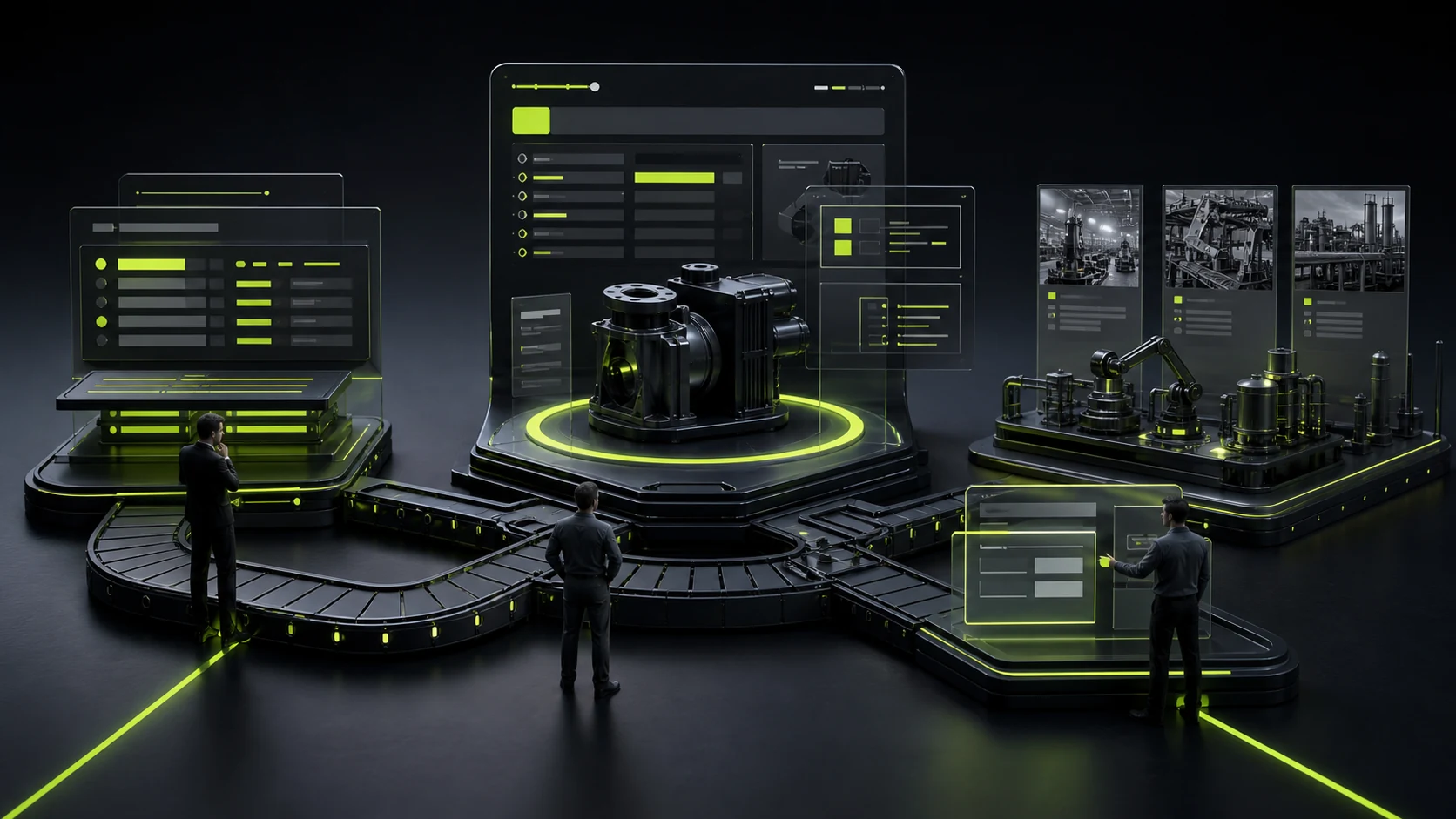
How to design a B2B product detail page? The more parameters there are, the more professional they are. Instead, they should help purchasers complete comparisons and make decisions more quickly
The task of the B2B product detail page is not to pile up all the product information, but to help the purchasing, engineering and management roles quickly determine: what it is, whether it is applicable, whether the parameters are met, what evidence is available, and how to obtain a quote or technical support next.
01 The product page is first and foremost a "decision page", not the online version of the product manual
Many industrial and B2B corporate websites directly split PDF product manuals into web pages: placing product images at the top, a very long parameter table below, and adding a sentence "Contact us". The information seems complete, but users have to find the key points from dozens of parameters by themselves and cannot quickly understand what scenarios the product is suitable for or how it differs from other models.
The tasks of web pages and PDFS are different. PDFS are suitable for complete archiving, while web pages need to establish a reading sequence even more. A stranger purchaser often first determines the category and purpose, then looks at the key indicators, and finally checks the certification, compatibility, delivery and technical documentation. Product pages should be organized along this decision-making path rather than in the order of internal enterprise materials.
02 On the first screen, let the user confirm that "the right product has been found."
In addition to the product name, it is best to provide a clear description, key model, typical application or core difference on the first screen. For enterprises with a large number of models, the series, specification range, status and related model entry can be displayed near the title, allowing users to quickly confirm that the current page is not another similar product.
Visually, it is not necessary to use huge product renderings. For high-tech products, clear physical pictures, structural diagrams, application environments and even interface details are more useful than an overly packaged concept poster. The role of pictures is to reduce the cost of understanding rather than simply add a sense of "sophistication".

03 The parameter table should be stratified. First, provide the key parameters, and then offer the complete specifications
Both the purchasing and engineering roles require parameters, but the degree of attention varies. A better approach is to first distill 5 to 8 key indicators that most affect judgment, such as size, power, precision, material, interface, temperature range, certification, etc., and then use a complete technical table to carry the remaining data.
For long tables, mobile devices also need to be taken into consideration. Don't simply condense the ten columns into small characters on the phone screen. You can break them down into attribute-value structures, group folds, or allow horizontal scrolling, and ensure that the relationship between the table header and the content is clear. Parameter units and terms should be consistent to avoid multiple sets of units or internal enterprise abbreviations on the same product page.
04 "Features" must be translated into values that users can understand
"High performance, stability and reliability, and advanced technology" cannot help users compare products. More effectively, it is necessary to explain the specific mechanisms and results, such as what structure is adopted to reduce maintenance frequency, which materials support specific environments, and which design shortens installation time.
The feature module can adopt the approach of "capability + evidence + scenario": it is not just about high-temperature resistance, but rather explains the temperature range, corresponding materials and typical applications. This not only avoids empty marketing but also provides more basis for judgment in technical procurement.

05 The application scenario can solve the problem of "parameters met, but is it really suitable for me?
Many users are not familiar with the product classification of enterprises, but they are familiar with their own application scenarios. Therefore, B2B product pages should simultaneously provide entry points for "understanding by product" and "understanding by scenario". The application module can display the industry, equipment location, process link or problem type, and be connected to a more complete solution page.
This layer is also meaningful for search, as users' search terms are often not internal models of enterprises, but rather "what to use in a certain scenario" or "what specifications a certain device is compatible with". Writing real application language into the page is more natural than piling up repetitive keywords.
06 Evidence should appear at the position where the decision is made, rather than being uniformly stuffed into the footer
Certification, testing, cases, warranties, customer industry and technical documents are all trust information. Concentrating them at the end of the page means that users cannot see the evidence when comparing products at the beginning. A better approach is to place the evidence close to the relevant content, such as placing test descriptions beside material advantages, case studies beside industry applications, and certifications near specifications.
If it involves CAD, data sheets, installation instructions, or white papers that need to be downloaded, clear file types, versions, and sizes can be provided. Don't let users only find out after clicking "Download Materials" that they need to fill in ten fields to get a public PDF.

07 The inquiry entry should include the current product context
When a user enters the consultation from a specific model, the system should automatically retain the product information and prevent him from re-entering "Which product am I consulting?" The form can be pre-filled with the model or carry the page URL in the background to let the salesperson know the source of the lead.
If the product decision is complex, multiple steps can be provided: obtaining quotations, consulting engineers, downloading data sheets, and viewing compatible products. Not all visitors are ready to submit purchase inquiries immediately. Providing appropriate entry points for users at different stages is more effective than just putting a "Contact Us".
08 For a search system, it is best for a page to have a clear single product theme
Google's current Product structured data documentation emphasizes that product-rich results typically revolve around a single product or variant pages of the same product. For pages that cannot be purchased directly online, Google also distinguishes scenarios such as product snippet. Even if a company does not engage in e-commerce, this principle still reminds us that the clearer the theme of the product page is, the more consistent the page name, description, images and specifications are, and the easier it is for the search system to understand.
Whether to implement Product structured data depends on the specific page and Google's current support requirements. Do not randomly mark pages that do not meet the conditions for the sake of "SEO". Structured data can only describe the existing content of a page and cannot replace the content itself.
09 Conclusion: Professionalism is not about having many parameters, but about enabling different roles to complete judgments quickly
A parameter table that is twenty screens long may seem very technical, but if the purchasing department cannot find the core indicators, engineers cannot find the data, and managers cannot see the application and evidence, it is still not a good product page.
A truly mature B2B product detail page will connect product positioning, key specifications, values, scenarios, evidence, data and inquiries into a decision-making path. The information has not decreased; it merely appears in the order required by the user.
Frequently Asked Questions
Does a B2B product page need to display prices?
It depends on the business model. Standardized products can display prices or price ranges. Strongly customized products can explain the inquiry method, MOQ, delivery or factors affecting the quotation, reducing the resistance caused by complete opacity.
How many items should be placed in the parameter table?
There is no fixed quantity. The key parameters that affect decision-making should be retained on the first screen or in the summary area. Complete specifications can be displayed in groups or technical materials can be downloaded.
Is it necessary to place case studies on the product page?
It is recommended to provide at least an application or case entry related to the product, which can help users determine whether the product is suitable for real scenarios.
Is it necessary to force the retention of information when downloading materials?
The disclosure of technical data does not necessarily require mandatory information retention. High-value data can be used to assess whether to exchange contact information, but the more fields there are, the higher the user threshold will be.
Can B2B Product pages use Product structured data?
It should be determined based on the nature of the page and Google's current support rules. Structured data must be consistent with the actual visible content on the page and meet the technical and content requirements of the corresponding type.
| Related Service | Learn More |
|---|---|
| Corporate Website Design Services | View Service Details |
| Project Consultation | Contact JVDS Design Studio |
| Design and Website Development Articles | Read More Related Articles |
 Link copied