
A proposal may win unanimous approval, yet months after launch, departments still use old templates, social media graphics remain inconsistent, and the corporate website looks entirely different from the product. This means the brand design never truly entered the organization.
The mistakes below extend from project kickoff through long-term governance. The earlier they are corrected, the lower the cost.
01 Treating a Brand Problem as Nothing More Than Outdated Visuals
Sales challenges, product confusion, and customer misperceptions are not necessarily solved by changing the Logo. Diagnose the business, target customers, and touchpoints first, then determine whether visual identity is the primary issue.
When a project addresses aesthetics alone, teams often tire of the result again quickly.
02 Failing to Define Brand Hierarchy and Scope
When the relationships among the master brand, products, sub-brands, and campaign names are unclear, the design team can only create isolated graphics instead of a unified system.
Before the project starts, define which assets will be updated, which will remain, and which are outside the scope.

03 Presenting Many Options but Shallow Directions
Showing more than a dozen Logo sketches at once creates the appearance of choice but may lack complete concepts and application testing. A few logical, distinct directions support better decisions.
Clients should evaluate the rationale and fit, not simply vote for the option they like.
04 Judging the Logo Only on a White Canvas
A Logo must be validated at small sizes, on light and dark backgrounds, on screens, in print, in motion, and in complex settings. A large rendering in a presentation does not represent real use.
Graphic complexity and wordmark legibility should be tested in actual conditions.
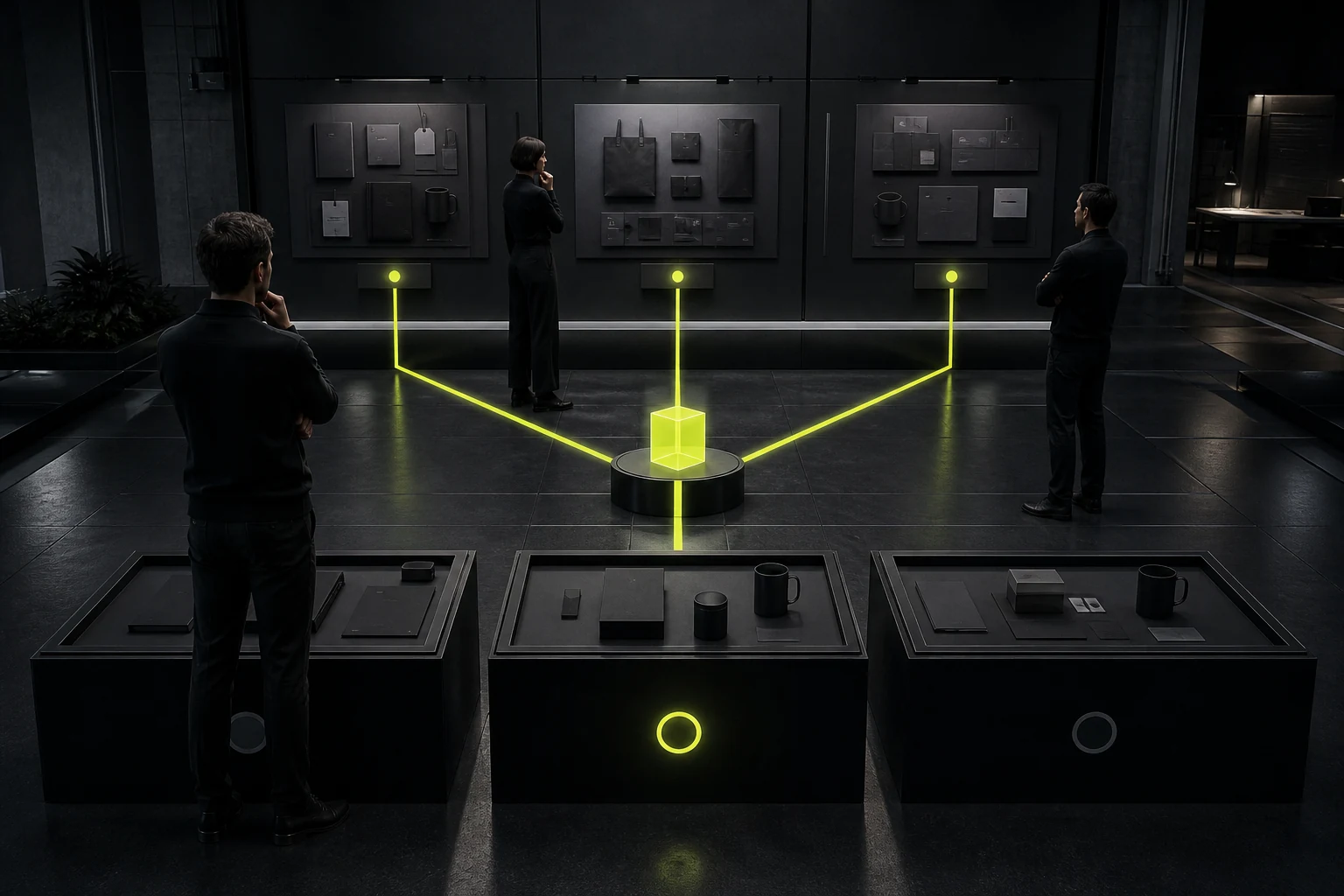
05 Creating VI Guidelines Disconnected from Daily Work
Guidelines may contain extensive standards yet omit presentation, social media, corporate website, and sales templates, leaving teams unable to use them directly.
Guidelines should be built around real, frequent touchpoints and include editable assets.
06 Overlooking Fonts, Images, and Third-Party Licenses
Fonts and stock images used in the design may be licensed only to the design firm, exposing the client to additional costs or infringement risk after launch.
Delivery should include asset sources, license terms, and alternatives.
07 Involving Too Many Decision-Makers and Scattered Feedback
When everyone requests changes based on personal preference, the direction is worn down into a compromise with no character. Appoint a final decision-maker, and tie feedback back to brand goals and usage criteria.
“No one dislikes it” is not the same as being distinctive.

08 Launching Without Transition or Governance
Mixing old and new branding, leaving vendors unaware of guidelines, and failing to update legacy pages quickly damages consistency.
Define the transition sequence, owners, template training, and exception approval process.
12 Common Mistakes
Stage | Mistake | Immediate Consequence |
|---|---|---|
Diagnosis | Replacing a business problem with an aesthetic problem | Misaligned refresh goals |
Scope | Failing to define brand architecture | Naming and visual conflicts |
Design | Many options but shallow concepts | Decisions based on preference |
Validation | No small-size or real-context testing | Failure after launch |
Delivery | Providing only a PDF guide | The team cannot implement it |
Governance | No owner or transition plan | Old and new assets remain mixed long term |
Frequently Asked Questions
Is the Logo the most important part of brand design?
The Logo matters, but positioning, the system, and implementation determine whether the brand can work over time.
Are more concepts always better?
Not necessarily. Compare how directions differ, their rationale, and their validation—not just the quantity.
How many pages should VI guidelines contain?
It depends on real usage contexts. Clear, actionable guidance matters more than page count.
Who should manage the brand after launch?
Appoint an internal brand owner and define workflows for design, content, and vendor use.
How should a brand project be accepted?
Review direction, identity, system, applications, files, licenses, and guidelines individually instead of judging only the final mockups.
Service | View |
|---|---|
Related Services | |
Related Reading | View Service Details |
Design Case Studies | |
Project Consultation |
 Link copied