Hiring someone to "add SEO" after launch often changes only titles, descriptions, and limited copy. The content system, page types, URLs, navigation, templates, front-end rendering, and performance that truly affect search discovery may already be fixed. The team then discovers there is no template for an industry topic or that every product shares one scrolling page when product terms need optimization.
SEO-friendly website design does not place search engines ahead of users. It gives the information users need clear, stable, accessible pages and lets search systems discover, understand, and select those pages.
01 Begin with Search Topics, Not Individual Keywords
One page can generally cover a group of searches with the same intent. "How much does corporate website design cost?", "corporate website development quote," and "cost to build a company website" can share one pricing topic. "Which corporate website design company is best?" reflects vendor selection and belongs in a separate procurement guide. Cluster topics first to determine page count and prevent one-page-per-keyword duplication and internal competition.
02 Information Architecture Determines What Can Be Discovered
Navigation is not an SEO keyword list; it contains the site's most important business and content entry points. Core services, products, solutions, cases, and resources need a clear hierarchy and contextual internal links. Important pages should not exist only inside search, filtered results, or a home-page carousel.
Content Layer | Typical Pages | SEO Role |
|---|---|---|
Core Business | Service pages for UI/UX, corporate websites, brand visuals, and more | Capture high commercial intent and demonstrate brand capabilities |
Scenarios / Industries | Solution pages for SaaS, finance, manufacturing, international markets, and more | Connect specific problems to service capabilities |
Evidence | Cases, methods, process, team, and FAQs | Build credibility and support conversion |
Knowledge Content | Articles about pricing, selection, processes, checklists, and methods | Address predecision questions and direct users to services |
Supporting Content | Contact, privacy, terms, help, and status | Complete trust, operations, and compliance |
03 Design Page Types Before Individual Pages
Define templates for service, case, article, category, product, and detail pages. Every template should specify editable fields, heading hierarchy, body copy, images, FAQs, author, breadcrumbs, related content, CTA, and structured data. Designing only a few visual samples and letting developers copy them ad hoc produces repeated titles, inconsistent structures, and an unmanageable site.
04 URLs Must Be Stable, Understandable, and Scalable
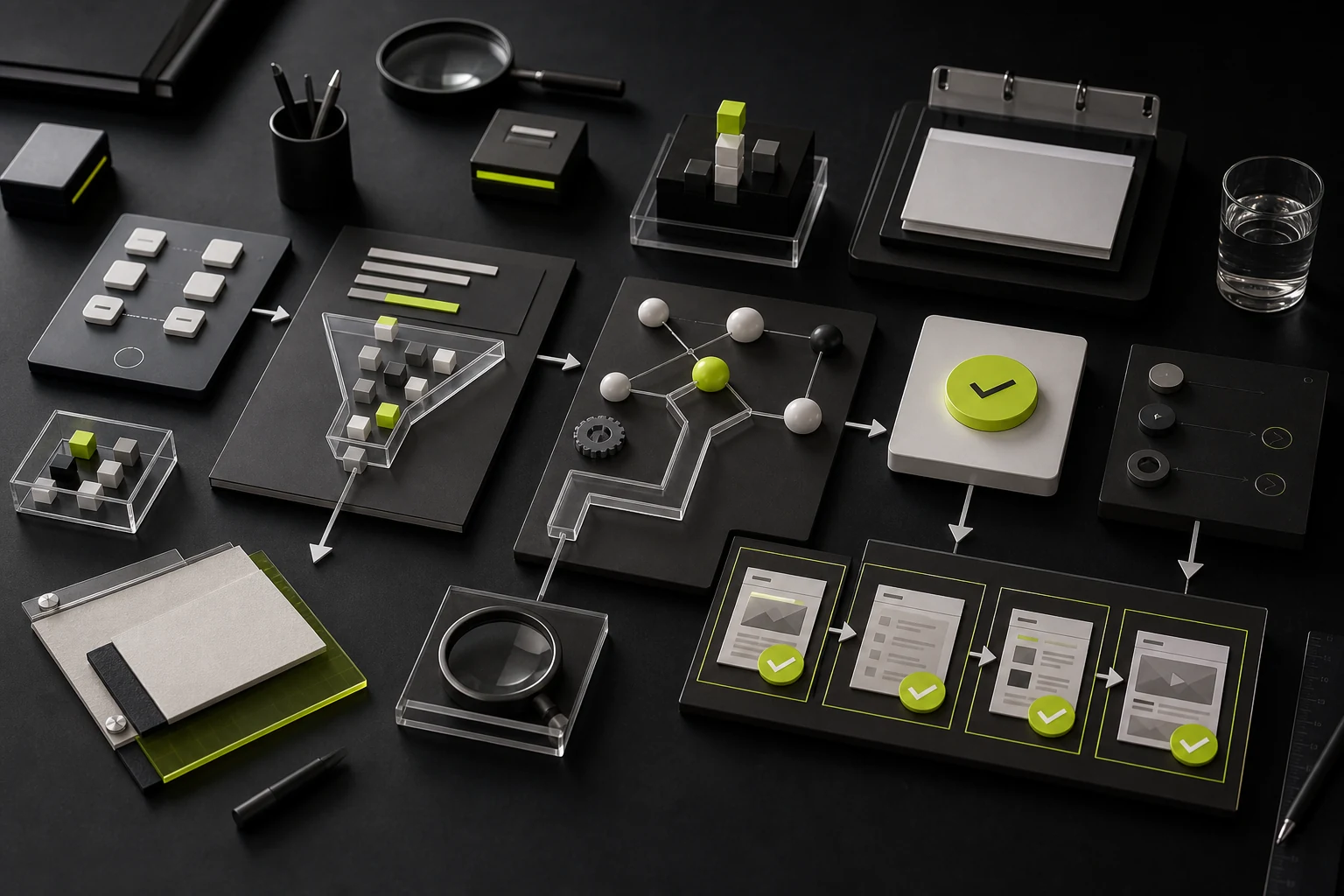
- □ Give core content independent, permanent URLs rather than relying on dialogs or front-end state;
- □ Keep paths concise and reflective of hierarchy, with consistent lowercase and hyphens;
- □ Avoid meaningless parameters, session IDs, repeated directories, and case variants;
- □ Standardize HTTP/HTTPS, www/non-www, and trailing-slash policies;
- □ Map old URLs to new URLs before redesign instead of redirecting everything to the home page;
- □ Define indexing rules for filters, sorting, and internal search before development.
05 Semantics and Crawlable Content Must Appear in Designs
SEO should not require developers to guess headings from a visual design. Mark H1, H2, body copy, lists, tables, buttons, breadcrumbs, and image captions. Important information should exist as real text rather than entirely as images, video captions, or Canvas animation. Core content should remain understandable if some scripts are disabled or resources fail.
Design Element | SEO and Usability Requirement |
|---|---|
Primary Heading | One clear H1 per page, aligned with the actual topic |
Section Headings | H2/H3 express content structure, not only visual size |
Link Text | Describes the destination instead of calling every link "Learn More" |
Images | Reasonable file size and dimensions; infographics have alternative explanations |
Collapsible Content | Accessible and rendered normally without permanently hiding core content |
Tables / Lists | Use semantic structure and remain readable and operable on mobile |
06 Align Canonicals, Sitemaps, and Index Rules
One piece of content may generate several URLs through protocol, domain, parameters, print versions, language, or device. Canonical tags identify a preferred version but cannot fix every duplication issue. Internal links, redirects, sitemaps, and canonical tags should point to the same final URL wherever possible.
Sitemaps should include only canonical, indexable pages returning a successful status. robots.txt controls crawl requests and is not equivalent to noindex. Decide how to handle test environments, back-office pages, previews, and duplicate filtered pages during architecture.
07 Multilingual Websites Need Independent URLs and Local Content
Google recommends distinct URLs for different language versions and relationships expressed through hreflang or similar methods. Do not force redirects based only on IP or browser language or translate navigation while leaving body copy unchanged. Multilingual SEO also needs local keywords, cases, currencies, contact details, and content—not word-for-word translation alone.

08 Control Performance and Mobile from the Hero Concept
Page speed cannot be solved only by compressing images at the end of development. Large hero videos, complex WebGL, many fonts, third-party scripts, and unstable layouts often originate in design decisions. Define mobile assets, static fallbacks, motion priorities, and image ratios during design.
Core Metric | Good Reference Threshold | Common Design / Development Causes |
|---|---|---|
LCP | Within 2.5 Seconds | Large hero image/video, fonts, server response, and render blocking |
INP | Under 200 Milliseconds | Main-thread scripts, complex interactions, third-party code, and event handling |
CLS | Under 0.1 | Images without dimensions, font replacement, asynchronous ads, and dynamic insertion |
Core Web Vitals are part of page experience, not the only ranking factor, and cannot guarantee top search placement. The goal is to help real users obtain content and complete tasks faster.
09 Content Production Must Be Designed into the CMS
SEO requires ongoing publishing and updates. The CMS should let editors manage Title, Description, URL, primary heading, body copy, image alt, author, publish date, canonical, social image, and related content while preventing accidental structural damage. Companies also need content status, review, preview, scheduled publishing, and version rollback.
10 Structured Data Must Represent Real Page Content
Organization, Breadcrumb, Article, and other structured data can help search systems understand pages, but must match visible content and pass relevant testing tools. Do not add reviews, pricing, or FAQs that do not appear on the page merely to pursue rich results.

11 SEO Acceptance Before Launch
- □ Every core topic maps to a target page without many near-duplicate pages;
- □ Page types, fields, and content templates remain sustainable;
- □ Navigation, breadcrumbs, body copy, and related content create clear internal links;
- □ URLs, redirects, canonical, hreflang, and sitemap agree;
- □ Core pages can be crawled, rendered, and indexed without accidental noindex;
- □ Title, Description, H1, and body copy accurately describe the page;
- □ Mobile, performance, HTTPS, and accessibility meet baseline requirements;
- □ Search Console, analytics, and critical conversion events are configured;
- □ Redesigned sites complete old-URL mapping and monitor 404s, indexing, and ranking changes.
12 Measuring Whether SEO Website Design Succeeds
Initially review crawling, indexing, errors, and page experience. Midterm, assess nonbranded topics, target-page rankings, qualified traffic, and content engagement. Long term, evaluate qualified leads, sales opportunities, and influenced revenue. Google explicitly states that requesting a crawl does not guarantee immediate indexing. The value of SEO design is a durable content and technical foundation.
Frequently Asked Questions
Does SEO apply only to article pages?
No. Services, products, cases, categories, and the home page all address search intent. Articles should support core business pages rather than compete with service pages for the same keyword.
Can SEO be added after launch?
Yes, but retrofitting costs more when information architecture, URLs, templates, or technology are unsuitable. Planning before a redesign is generally safer.
Does visual design affect SEO?
Indirectly, through readability, semantics, image size, mobile experience, and interaction performance. Visual design and SEO do not conflict when governed systematically.
How many times should a keyword appear?
There is no fixed count. Use the language users search naturally and answer the topic completely. Mechanical repetition reduces reading quality.
Does technical SEO guarantee a top-10 ranking?
No. Technical foundations help content be found and understood, but rankings also depend on relevance, content value, credibility, competition, and sitewide signals.
Service | View |
|---|---|
Corporate Website Design and Website Development | |
Design and SEO Content | |
Project Inquiry |
Need design or website development services?
JVDS Design Studio is a professional design studio focused on digital product experiences and brand identity. We work with businesses in China and overseas that want to strengthen their brand image, improve user experience and grow their business, providing clear, usable UI/UX design, high-quality website design and development, app and mini-program development, and cohesive, distinctive brand identity design.
Planning a corporate website, a multilingual site or a redesign? Tell us about your audience, existing website and the work you need.
 Link copied