Many mobile app proposals summarize the work as “iOS + Android + admin,” which looks complete until the project starts and no one owns requirements, UI, APIs, data, privacy policies, store accounts, or operational monitoring. Mobile app development is not the sum of several codebases; it is an end-to-end delivery chain from product goals through long-term maintenance.
A complete project can be divided into 12 modules. Not every engagement needs to purchase all 12, but every excluded item should identify who will complete it, when it will be done, what inputs it requires, and what risks the omission creates.
01 Module 1: Product Discovery and Goal Definition
Before work begins, define the business goals, target users, core scenarios, alternatives, existing systems, success metrics, and first-release boundaries. If the requirement is still only one sentence, it is too early to lock in a total development price.
- Common outputs: Project Brief, user roles, core tasks, operational objectives, risk assumptions and version routes.
- Key findings: Release 1 must verify what is available and what functions can be extended.
- Client input: operational rules, available data, compliance requirements, internal decision-making and budgetary time.
02 Module 2: Requirements and the PRD
A PRD is not a list of feature names. It should define roles, prerequisites, primary flows, exceptions, data, permissions, acceptance criteria, and priorities. Two features with the same name can require entirely different engineering effort when their rules differ.
Requirements Dimension | It has to be written. |
|---|---|
Users and Roles | Who uses, what can be done, what is the range of data? |
Operational rules | Conditions, calculations, status, approval, restrictions and exceptions |
Pages and Processes | Main process, return, revocation, failure and recovery |
Data and interfaces | Fields, sources, synchronization, permissions, and validation |
Acceptance criteria | How completion will be tested and approved |
03 Module 3: UX Flows and Interactive Prototypes
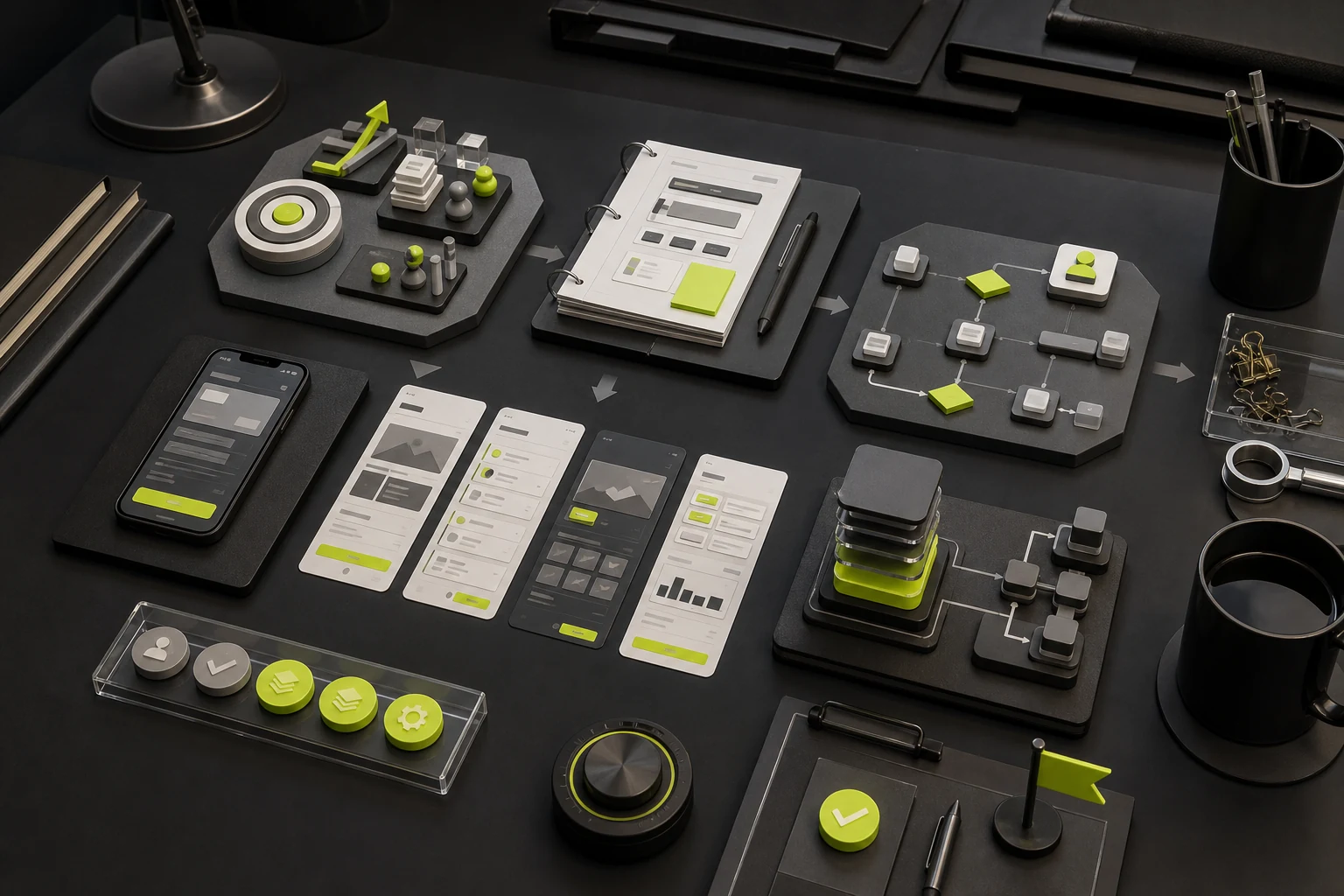
Before development, use workflows and prototypes to validate the information structure, core tasks, and exception paths. A prototype is not merely a presentation; it aligns product, design, and engineering on the meaning of the requirements.
04 Module 4: UI Design and the Design System
The UI phase defines hierarchy, brand expression, components, icons, charts, states, motion, and platform-specific behavior. Products intended to evolve over time also need a design system and component rules that keep future releases consistent.
05 Module 5: Technical Architecture and Solution Design
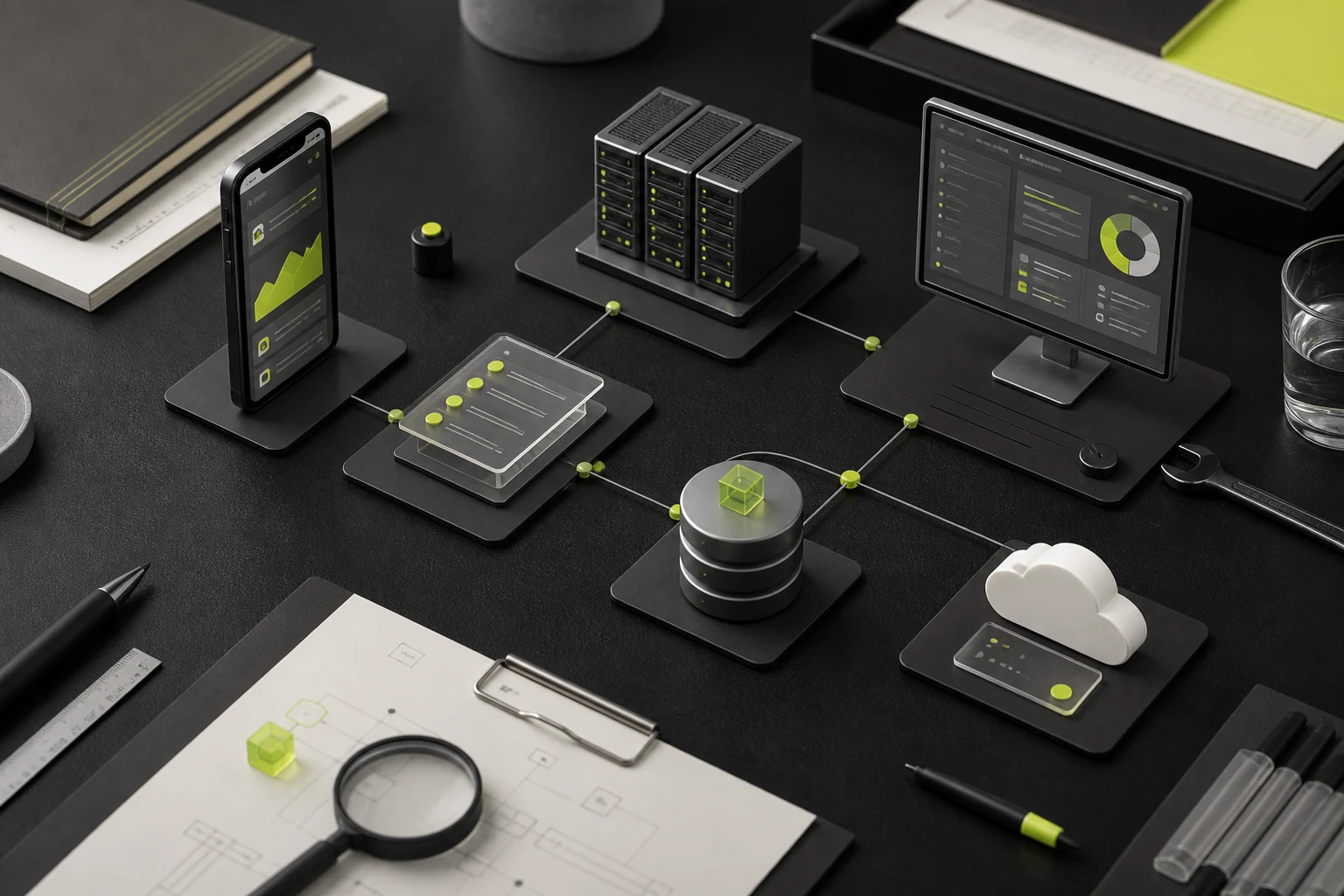
The technical solution should define the client architecture, backend, database, APIs, deployment model, third-party services, security, monitoring, and scaling approach. The NIST Secure Software Development Framework recommends integrating security requirements, supply-chain risk, and verification throughout the development lifecycle.
Technology decision-making | Need an explanation. |
|---|---|
Client Architecture | Why native, cross-platform, a mini app, or a PWA is appropriate |
Backend and Database | Services, data models, caches, permissions and extensions |
Integrations | Internal systems, third-party services, version and error processing |
Deployment environment | Development, testing, staging, and production environments, plus backup and rollback |
Security and privacy | Authentication, encryption, logs, permissions, SDK and data deletion |
Maintenance policy | Reliance on upgrades, system versions, monitoring, and incident response |
06 Choosing Native, Cross-Platform, Mini App, or PWA
Approach | Advantages | Suitable | Be careful. |
|---|---|---|---|
iOS/Android | Platform capacity and performance control | High performance, depth system capabilities, long-term core products | Higher cost of two-end teams and maintenance |
Cross Platform mobile app | Reuse more codes and deliver more efficiently | Standard operations, cross-platform synchronization | Complex native capabilities still require platform-specific implementation |
Mini app | No separate installation, with easy distribution and access | Lightweight services, transactions, membership, and WeChat use cases ecology | Limited platform capacity, rules and access to traffic |
PWA/Web App | Update fast through Web delivery | Content, tools, low installation requirements | Limited access to system capabilities and app-store distribution |
Do not choose technology because it is fashionable. Compare options based on functionality, performance, team capability, budget, platform access, maintenance, and distribution strategy.
07 Module 6: Client Application Development
Client applications handle screens, interaction, state, caching, permissions, device capabilities, network behavior, and backend communication. Scope should explicitly cover iOS, Android, tablets, supported OS versions, orientation, dark mode, localization, and accessibility.
08 Module 7: Backend, APIs, Database, and Admin Console
Most business mobile apps depend on backend services. Backend and admin scope is often underestimated because stakeholders primarily see the mobile client. In practice, it may include users, content, orders, permissions, review workflows, configuration, messaging, reports, logs, and operational tools.
- API design, version, authentication, rate limiting, error code and document.
- Database structure, migration, backup, recovery and data access.
- Manage roles, approvals, batch operations, import export and audit in the back office.
- Documents, pictures, videos, messages and task handling.
- Production environment deployment, monitoring, alarms, logs and capacity.
09 Module 8: Third-Party Services and System Integration
SMS, payments, maps, push notifications, authentication, customer support, analytics, cloud storage, content moderation, and internal enterprise systems can each introduce separate fees, accounts, constraints, and data responsibilities. The contract should define who provisions, pays for, and maintains each service, as well as what happens during an outage.
10 Module 9: Security and Privacy
OWASP MASVS covers mobile-app verification across storage, cryptography, authentication, networking, platform interaction, code quality, tamper resistance, and privacy. At minimum, the scope should address sensitive data, permissions, third-party SDKs, logging, vulnerability remediation, and security-incident response.
- Only data necessary to complete operations are collected.
- Sensitive data are not entered into explicit storage, log, notification or interception.
- Certification and authorization are validated at the service level and cannot be dependent on the client alone.
- The third-party SDK's data practices is consistent with the disclosure by the store.
- Provide technical support for account deletion, data deletion and privacy settings.
11 Module 10: Testing and Quality Assurance
Test category | Coverage |
|---|---|
Functional testing | Primary workflows, exceptions, edge cases, permissions, and business rules |
Interfaces and Data | Success, failure, timeout, duplicate requests, synchronization, and recovery |
Compatibility | System version, device, resolution, language and permissions |
Performance | Startup, rendering, network, memory, crashes, and UI freezes |
Security and privacy | Storage, transmission, authentication, logging, SDKs, and data deletion |
Accessibility | Text scaling, contrast, screen-reader support, focus, and touch-target size |
Return release | Version coverage, defects, fix verification, staged rollout, and rollback |
12 Module 11: Store Submission, Release, and Deployment
Launching an app involves more than uploading a build. Apple App Store and Google Play review metadata, screenshots, privacy policies, data disclosures, age ratings, demo accounts, and compliance with platform rules. The client should own the store accounts and grant the vendor controlled access.
- Prepare store names, descriptions, keywords, screenshots, previews, and contact information.
- Configure certificate, signature, package name, version, environment and release permissions.
- Provide audit accounts, special hardware or functionality.
- Address review feedback, fix issues, resubmit, and document versions.
- Create a staged-release, monitoring, rollback, and launch checklist.
13 Module 12: Monitoring, Maintenance, and Iteration
After launch, teams need to monitor crashes, APIs, performance, critical tasks, and business events. Warranty, operations, platform-version upgrades, and new features are separate responsibilities and should be distinguished in the contract.
Type of service | Typical range |
|---|---|
Quality assurance | Bug and compatibility issues identified |
Operations | Hosting, certificates, backups, monitoring, alerts, and capacity |
Version maintenance | Operating systems, app-store policies, SDKs, and dependency upgrades |
Product iterative | Experiments on new functions, adaptations, data, operation and growth |
SLA | Incident severity, response time, interim workaround, remediation, and communication |
14 Dividing Responsibilities Between Client and Vendor
Matters | Client primary responsibility | Vendor primary responsibility |
|---|---|---|
Operations and compliance | Operational rules, qualifications, legal texts and final decision-making | Risks raised, technical requirements met, boundaries recorded |
Content and data | Provision of legitimate content, data and authorization | Import, display, protection and technical handling |
Accounts and costs | Owns app-store, cloud, domain, and third-party accounts | Assist in configuration, use minimum permissions and transfer |
Acceptance and feedback | Provide consolidated feedback and milestone approvals on time | Provide testable builds, fix defects, and document versions |
Launch | Identification of operators and budgets | Provide the agreed QA, operations, or iteration support |

15 Deliverables for Each Project Phase
Phase | Key delivery | Focus on acceptance and inspection |
|---|---|---|
Requirements | Brief, PRD, process, scope and plan | Alignment of objectives, rules, priorities and borders |
Design | Prototype, UI, component, status and description | Core tasks, exceptions, platform suitability and enforceability |
Development | Code, interface, admin console, environment and version | Functions, data, permissions, build process, and documentation |
Test | Test cases, defects, reporting and repair records | High-risk processes, stability, security and compatibility |
Online. | Store listing, production environment, accounts, and release records | Primary ownership, review records, monitoring, and rollback |
Handover | Source code, designs, documentation, keys, accounts, and unresolved items | Clients can build, deploy and maintain independently |
16 Work Commonly Excluded from the Base Estimate
- Corporate identity materials, business licenses, privacy policies, and legal compliance services.
- App Store and Google Play developer accounts, servers, text messages, maps, payments and cloud service charges.
- Official texts, translations, photographs, videos, illustrations and commercial fonts.
- Data cleansing, complex migration and third-party interface adaptation of old systems.
- Hardware, physical networking, bluetooth, specialized equipment and sub-linear testing.
- Large-scale security tests, penetration tests, insurance or industry certification.
- Long-term operations, customer service, content auditing, marketing and growth.
- New functions beyond scope, urgency, repeated audits and changes in platform policy.
17 Example Scope for a Membership Mobile App
Consider a membership app whose first release includes registration, content, booking, payments, messaging, and loyalty points. Discovery reveals that the real risks are identity, refunds, concurrent booking, messaging vendors, admin permissions, and data migration. To protect the launch date, the team moves loyalty points to release two and first completes a core service flow that can be tested, refunded, and monitored. This composite scenario shows that full-service development also creates value by actively reducing first-release scope.
18 Frequently Asked Questions
Does Mobile App Development Always Include UI Design?
Not necessarily. Some companies only undertake development. The request for quotations should be clear as to whether products, prototypes, UIs, design systems and development searches are included.
Is an Admin Console Included by Default?
Not by default. The roles, functions, pages, reports and permissions of the back office need to be listed independently.
Does Building for Both iOS and Android Double the Cost?
Not necessarily. The cost structure of the two parent, cross-platform and shared back end is different and still needs to be assessed according to functional and maintenance requirements.
Can a Development Company Guarantee Store Approval?
There is no guarantee that the competent platform will be approved. Vendors should comply with the rules, identify risks in advance, prepare information and assist with audits.
When Should Source Code Be Delivered?
It shall be agreed at a stage in the contract. Clients should have controlled warehouses and production accounts on a continuous basis, rather than receiving a compressed package only after the tailings.
Conclusion
Mobile app development is not three line items for client code, an admin console, and servers. It is a complete chain from goals and requirements through design, architecture, development, testing, store release, and maintenance. If any link lacks a clear owner, risk accumulates late in the project.
During procurement, confirm for every module what is included, excluded, supplied by the client, delivered by the vendor, accepted, transferred, and covered by an exit plan. With a limited budget, reduce the first-release scope instead of weakening requirements, security, testing, and handoff at the same time.
Next Step
Before requesting a mobile app proposal, document the target users, core scenario, platform requirements, data sources, third-party integrations, compliance needs, operating model, and launch plan. A comparable estimate depends on clearly assigned responsibilities and deliverables.
Need design or website development services?
JVDS Design Studio is a professional design studio focused on digital product experiences and brand identity. We work with businesses in China and overseas that want to strengthen their brand image, improve user experience and grow their business, providing clear, usable UI/UX design, high-quality website design and development, app and mini-program development, and cohesive, distinctive brand identity design.
Working on a B2B system or an app? Share your current screens and key user tasks so we can discuss the design scope.
 Link copied