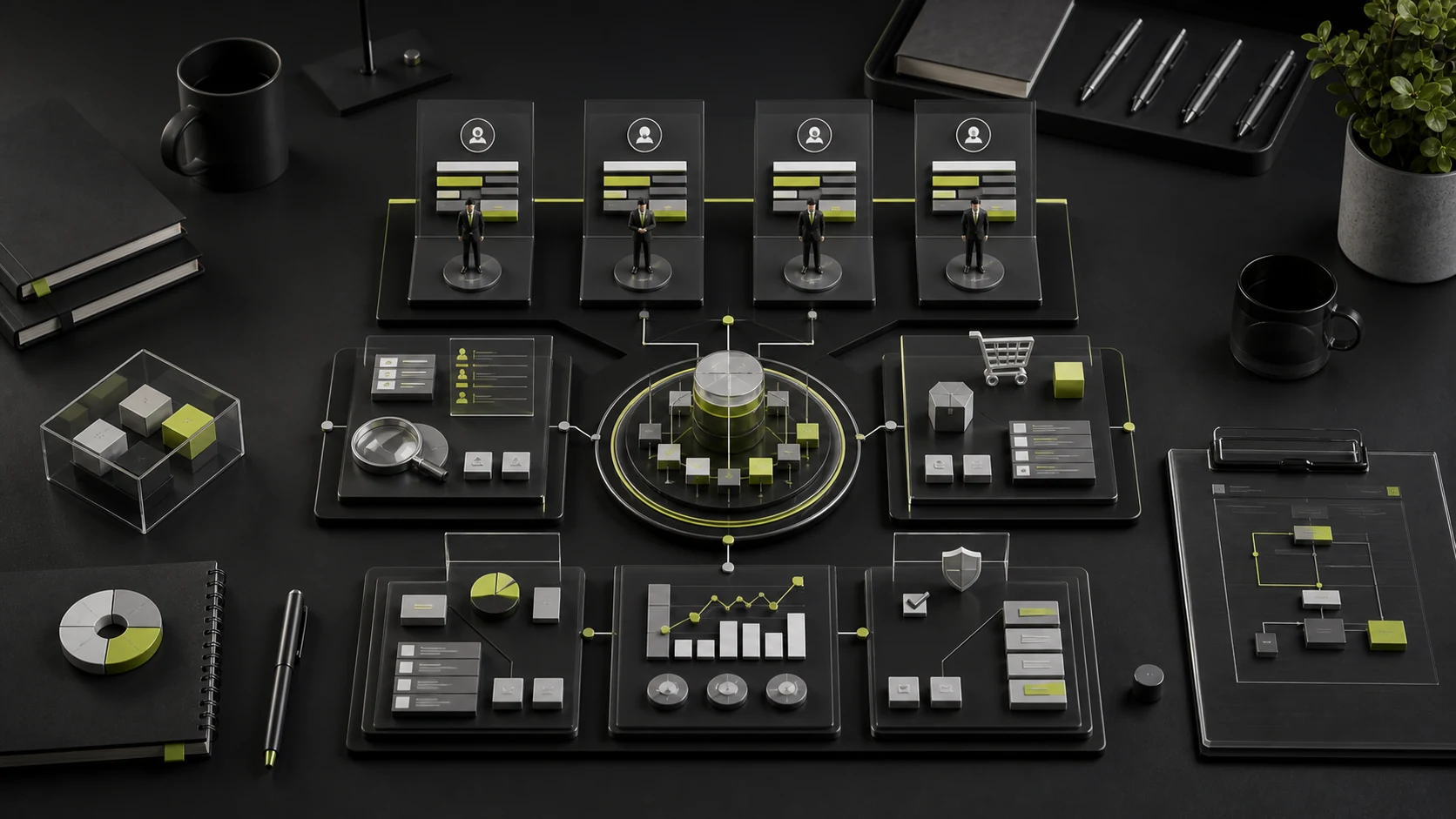
The most common mistake on an enterprise-services website is assuming there is only one visitor. A sales leader wants to know whether the solution can drive growth. A business team cares about process efficiency. IT evaluates architecture, security, and integrations. Procurement compares scope, pricing, and risk. Management needs to understand whether the investment is justified. If the website speaks to only one of these groups, progress often stops when the link is forwarded internally.
Complex B2B decisions are usually made by a group. A website cannot replace sales, solution consulting, or procurement, but it can help stakeholders reach consistent information sooner and reduce repeated requests for materials and explanations.
01 Map Real Decision Roles Instead of Using the Generic Label “Enterprise Customer”
Role | Primary Question | Evidence Required | Most Likely Next Step |
|---|---|---|---|
Executives / Business Owners | Why act now? What are the value and risks? | Business outcomes, strategic fit, customer cases, and implementation control | Review a solution brief or schedule an executive discussion |
Business Leaders | Will it improve my processes and KPIs? | Scenarios, workflows, roles, before-and-after changes, and implementation approach | Request a demo or requirements assessment |
IT / Security | Can it integrate with current systems? Is it secure and manageable? | Architecture, APIs, permissions, data, security, deployment, and operations | Request technical materials or a technical meeting |
Procurement / Legal | Are scope, cost, and responsibilities clear? | Deliverables, SLA, contract, compliance, and vendor capabilities | Request a quote or begin an RFP |
Frontline Users | Is it easy to learn and use, and will it reduce work? | Real interfaces, task demonstrations, training, and support | Start a trial or watch a demo |
Finance / Risk | Are costs predictable? How are risks controlled? | Pricing model, ROI logic, audit controls, and risk measures | Budget review or risk assessment |
One person may fill several roles, and their sequence varies with company size. Before planning the website, interview sales, presales, customer service, and delivery teams to identify who enters first, who can veto the project, who drives it, and who ultimately uses the solution.
02 Establish One Shared Narrative for Every Stakeholder
If each stakeholder sees a completely different story, internal discussions will expose contradictions. A B2B services website should first establish a shared framework:
- Audience: define the industry, company size, business stage, or typical team;
- Core problem: describe the current state in the customer’s language before presenting product modules;
- Solution approach: explain the product, service, process, and boundaries;
- Business outcomes: identify the metrics and conditions that may improve, without making claims that cannot be substantiated;
- Implementation path: explain the collaboration required from evaluation through launch;
- Credible evidence: case studies, methodology, technology, customers, and delivery capabilities;
- Next step: let visitors at different levels of readiness choose an appropriate action.
This shared narrative should connect the homepage, solutions, case studies, and sales materials. The architecture described to IT should support the promises made on business pages. The scope provided to procurement should also match the case studies and demos.
03 The Homepage Is an Entry Point to Shared Understanding, Not a Company Introduction
Within the first ten seconds, a new visitor should be able to answer four questions: What does this company do? Who is it for? What is the primary value? Is it worth continuing?
Recommended Homepage Sequence
Section | Question to Answer | Content Focus |
|---|---|---|
Hero | Whose problem do you solve, and what is the problem? | Audience, problem, approach, and one primary CTA |
Credibility Evidence | Why should visitors believe you? | Customers, qualified data, case studies, or certifications |
Key Scenarios | Which tasks use the solution? | Organize by problems or workflows, not only features |
Solution | How does the problem become an outcome? | Relationships among product, service, implementation, and roles |
Product Evidence | How does the actual system work? | Interfaces, flows, architecture, or a demo |
Case Studies | How have others implemented it? | Context, challenge, process, outcome, and scope |
Technology and Security | Can IT continue the evaluation? | Integrations, security, deployment, and access to documentation |
Implementation and Support | Is the project controllable? | Milestones, responsibilities, training, and maintenance |
CTA | How much commitment does the next step require? | Learn, download, demo, assess, or inquire |
Do not crowd the hero with a brand slogan, ten capabilities, and multiple buttons. Begin with one clear proposition, then let later sections address the needs of different stakeholders.

04 Organize Solution Pages Around User Tasks, Not Internal Departments
Many B2B services websites name pages “Product Center,” “Solution A,” and “Solution B,” forcing visitors to learn the provider’s internal organization. More effective solution pages usually select one of the following dimensions:
- Business problem: increase lead conversion, reduce manual processing, or unify data;
- Key workflow: acquisition, approval, delivery, operations, or after-sales service;
- Role: sales, operations, management, or IT—but each role must have a distinct task;
- Industry: only when workflows, regulations, or scenarios genuinely differ;
- Product capability: for visitors who understand the problem and are ready for deeper evaluation.
One page should not carry every dimension at once. A practical structure uses problems or scenarios for primary navigation, then treats industries, roles, and product capabilities as cross-links and content tags.
Structure of a Strong Solution Page
- Scenario and current problem;
- Roles involved;
- Key workflow and where the product intervenes;
- Measurable goals and applicable conditions;
- Evidence from the product interface, data, or architecture;
- Implementation steps, system integrations, and responsibilities;
- Related case studies, documentation, and next step.
05 Case Studies Must Be Verifiable by Different Stakeholders
A customer Logo and a sentence claiming “significant efficiency gains” cannot support a complex purchase. A case study should explain what happened, what the provider delivered, what the customer contributed, and under which conditions the outcomes appeared.
Case Study Information | What Executives Need | What Business Teams Need | What IT / Procurement Need |
|---|---|---|---|
Project Context | Why the investment was justified | The former workflow and pain points | System and organizational environment |
Objectives | Strategic and business goals | Specific task metrics | Scope and constraints |
Solution | Core path | Flows and functionality | Architecture, integrations, and implementation approach |
Implementation | Whether risk was controllable | How the teams collaborated | Timeline, resources, migration, and launch |
Outcomes | Business and organizational outcomes | Changes in usage and efficiency | Stability, support, and scalability |
Boundaries | Conditions under which the outcomes apply | Problems that were not solved | Responsibilities of the customer, provider, and third parties |
Do not invent percentages when authorized data is unavailable. Instead, publish the verifiable portions of delivery scope, decision process, launch approach, role coverage, and customer feedback. Limited but authentic evidence is more credible than exaggerated growth figures.
06 IT and Security Content Cannot Stop at “Private Deployment Supported”
Technology and security stakeholders often have veto authority in enterprise procurement. The website does not need to disclose sensitive architectural details, but it should provide enough information to determine whether a technical evaluation is worthwhile.
Technical Information Worth Publishing
- Supported deployment models and applicable conditions;
- APIs, Webhooks, single sign-on, and common integrations;
- Role permissions, audit logs, and data export;
- Data storage, backups, disaster recovery, and availability;
- Privacy, security certifications, or the boundaries of assessments;
- Browser, device, network, and environmental requirements;
- Version updates, maintenance windows, and support channels;
- Access to technical white papers, security questionnaires, or materials available under an NDA.
Claims to Avoid on Technical Pages
- “Bank-grade security” without a standard, scope, or responsibility;
- “Seamless integration with every system” without API boundaries;
- “99.99% availability” without a service scope and SLA conditions;
- “Fully compliant” without stating the region, regulations, and customer responsibilities.
Technical credibility comes from verifiable boundaries, not absolute adjectives.
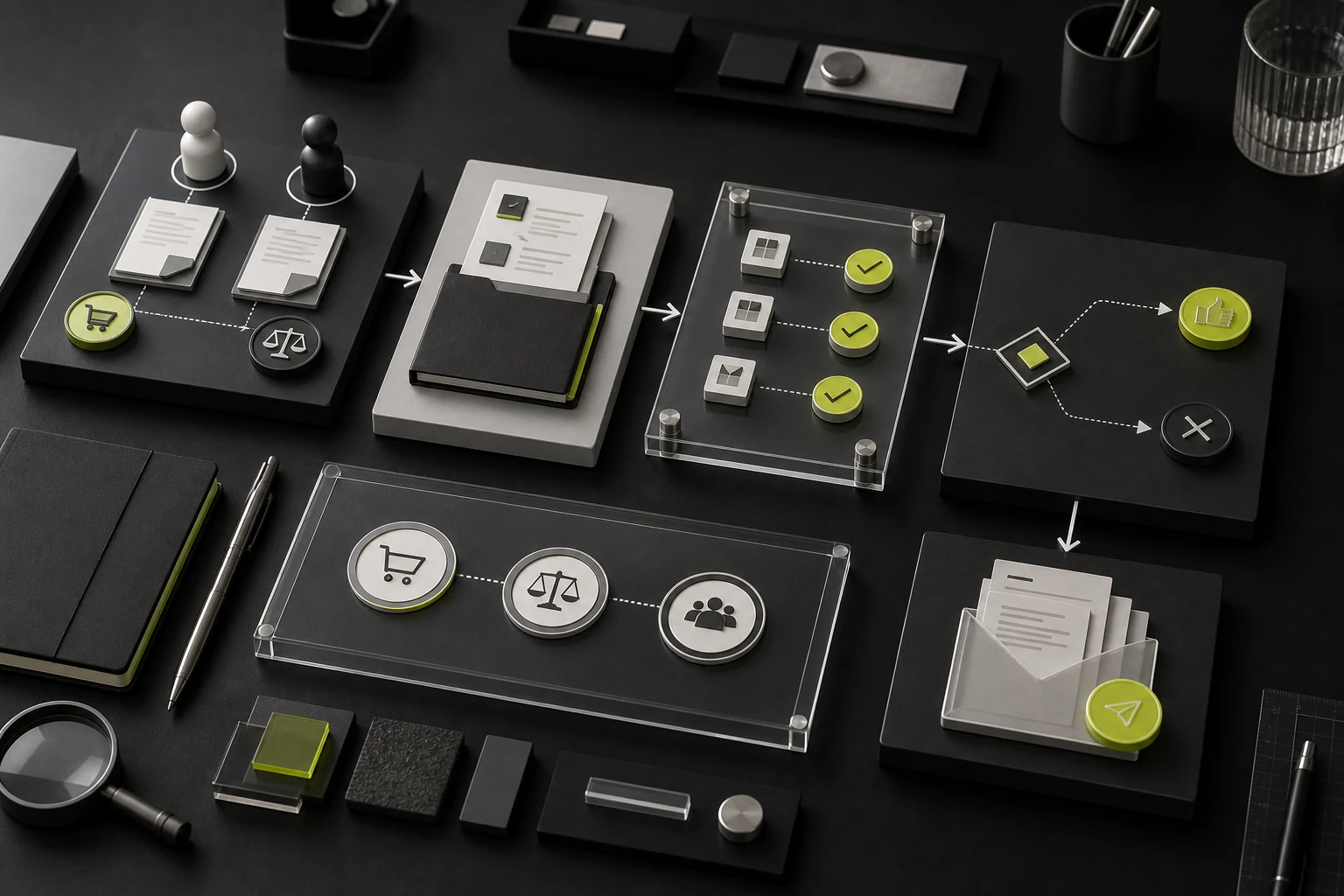
07 Procurement and Legal Need a Forwardable Information Package
After understanding a solution on the website, a visitor often needs to forward information to internal colleagues. If every fact is scattered across Web pages, the internal champion must create screenshots and explain the solution, which can distort the message.
Recommended Tiered Materials
Material | Primary Use | Recommended Content |
|---|---|---|
One-page Solution Brief | Initial internal forwarding | Problem, audience, value, workflow, and next step |
Product / Service Guide | Business evaluation | Scenarios, capabilities, interfaces, scope, and case studies |
Technical White Paper | IT evaluation | Architecture, integrations, security, deployment, and operations |
Security and Privacy Statement | Security / legal review | Data, permissions, responsibilities, certifications, and processes |
Implementation Guide | Project owner | Stages, resources, data migration, training, and launch |
Procurement Checklist | Procurement / finance | Service scope, pricing logic, SLA, and key contract terms |
Customer Case Study | Multi-stakeholder evaluation | Context, process, outcomes, conditions, and scope |
Whether a download should require a form depends on the value and sensitivity of the material. Excessive friction on basic product information drives away early-stage evaluators. Sensitive security materials can be provided after company verification or an NDA.
08 Layer CTAs by Purchase Readiness
“Contact Us Now” is not appropriate for every visitor. Enterprise purchases usually require a gradual increase in commitment.
Visitor Stage | Appropriate CTA | User Commitment |
|---|---|---|
Initial Learning | Explore scenarios, watch a demo, or read a guide | Low |
Building Interest | Download a solution brief, subscribe, or review a case study | Relatively low |
Solution Evaluation | Request a demo or technical materials | Medium |
Project Confirmation | Submit requirements, schedule a workshop, or request scope guidance | Relatively high |
Procurement Execution | Request a quote, RFP response, or contract discussion | High |
Each page should have one primary CTA and a small number of secondary CTAs. A technical page may emphasize “Request Technical Materials,” while a case study may use “Evaluate a Similar Scenario.” Not every page should send visitors to the same contact form.
09 How to Keep Multi-stakeholder Content from Becoming Large and Confusing
Use a “Shared Core + Role-specific Depth” Model
Keep business value, product facts, and implementation approach in a shared core instead of rewriting them. Role pages should add only that stakeholder’s decision questions, evidence, and next step.
Use Content Tags Instead of Duplicating Pages
One case study can be tagged by industry, scenario, role, product, and deployment model, then referenced from different entry points. Do not create a near-duplicate case study for every industry and role.
Create an Evidence Hierarchy Within Each Page
Provide the conclusion in the hero, explanation in the body, and verification through tables and documents. Executives can scan quickly while specialists can go deeper, without requiring an entirely different site for every stakeholder.
Use Clear URLs and On-site Search
Solutions, industries, case studies, resources, and technical documentation should have stable relationships. A user entering through a deep link sent by sales should still understand where the page belongs and how to continue exploring.

10 Composite Scenario: Why “Reduce Cost and Increase Efficiency” Fails
A B2B product homepage says only “Helping enterprises reduce costs and increase efficiency,” followed by a list of feature modules. Executives cannot identify the relevant business. Business teams cannot see how current workflows will change. IT cannot find deployment or API information, and procurement cannot determine the service scope. Sales must recreate the materials for every conversation.
The redesign should not add more promotional language. It should first define a proposition such as “order and fulfillment coordination for multi-location service businesses,” use one representative workflow to show where the product intervenes, and then provide operational metrics, real interfaces, technical integrations, and implementation materials. The website becomes a shared entry point for internal evaluation rather than a promotional page.
This is a composite explanation of issues found across several types of B2B projects. It does not describe a single client or claim a validated conversion result.
11 How to Measure Whether a Multi-stakeholder Website Works
- Visits and reading depth for different stakeholder entry points;
- Use of case studies, technical materials, and implementation documents;
- The combination of pages viewed before a demo request;
- Completeness of company, role, scenario, and purchase-stage fields in forms;
- Whether sales sends fewer repetitive foundational materials;
- Whether questions from IT and procurement move earlier in the first conversation;
- Time from first visit to demo, proposal, and procurement;
- Whether high-value pages assist long-cycle deals, instead of evaluating only the final click.
The effectiveness of a B2B services website cannot be judged by direct form conversion alone. Many pages educate, support internal forwarding, and reduce risk. Evaluation should combine CRM data, sales records, and content paths.
Frequently Asked Questions
1. Should Executives, IT, and Procurement Each Have a Separate Homepage?
Usually not. Establish a shared homepage first, then provide entry points, materials, and evidence for key roles. Consider a separate landing page only when the business proposition and usage scenario truly differ.
2. Should a B2B Website Lead with Features or Value?
Explain the user problem and business value first, then use features to prove how the solution works. Value alone is vague; features alone do not establish priorities.
3. How Much Technical Information Should Be Public?
Publish enough foundational information to assess fit. Sensitive architecture, security reports, and customer-environment details can be provided after identity verification or under an NDA. Do not hide every substantive fact behind “Contact Sales.”
4. What If We Do Not Have Many Customer Case Studies?
Provide process case studies, a demo environment, implementation methodology, team experience, and clear boundaries—but never fabricate customers or outcomes. A few detailed case studies are more effective than a large Logo wall.
5. Should the Website Publish Pricing?
A standardized product can publish packages or pricing logic. Complex custom services can explain cost factors, minimum scope, and the quotation process. Saying nothing about cost increases low-quality conversations.
6. Will Multi-stakeholder Content Hurt SEO?
If every page serves a distinct search task and contains substantive content, the pages can form a useful topic structure. Large numbers of near-duplicate pages may instead create duplication and keyword competition.
Conclusion: Help Stakeholders Share Facts, Not Just a Slogan
The job of a B2B services website is to help an internal champion bring clear, credible, forwardable materials into the decision process. Executives, business teams, IT, and procurement do not need the same marketing slogan. They need different depths of evidence around the same solution.
Establish the shared narrative first, then design stakeholder entry points, case-study evidence, technical materials, and layered CTAs. The website can then evolve from a brand showcase into part of the sales and procurement process.
Need design or website development services?
JVDS Design Studio is a professional design studio focused on digital product experiences and brand identity. We work with businesses in China and overseas that want to strengthen their brand image, improve user experience and grow their business, providing clear, usable UI/UX design, high-quality website design and development, app and mini-program development, and cohesive, distinctive brand identity design.
Planning a corporate website, a multilingual site or a redesign? Tell us about your audience, existing website and the work you need.
 Link copied