If a launched product changes only two or three pages each month, a full-time designer may sit idle. If a complex SaaS product changes rules and holds reviews every day, outsourcing all design to a project-based team repeatedly loses context. A poor choice usually reflects a mismatch between the operating model and the nature of demand, not weak employees or vendors.
Outsourcing provides temporary capabilities and flexible capacity; full-time designers support continuous involvement and accumulated business knowledge. Many companies need a hybrid: retain core capabilities internally and use external specialists for defined work.
01 Determine Whether Demand Is Project-Based or Operational
Brand refreshes, corporate website redesigns, zero-to-one products, and design-system rebuilds have clear beginnings and endings. Routine releases, growth experiments, campaigns, and development reviews continue indefinitely and are more operational.
External teams can deliver project-based work through a defined scope and stages. Operational work requires immediate communication and context; long-term outsourcing can turn every small issue into a new brief.
Question | Favors Outsourcing | Favors Full-Time |
|---|---|---|
Demand frequency | Periodic, with clear peaks and valleys | Continues every week |
Business change | Scope can be fixed during the project | Rules and priorities change frequently |
Collaboration intensity | Scheduled review points are sufficient | Daily participation in product and engineering decisions |
Capabilities needed | Multiple roles or specialists needed temporarily | Stable core capabilities needed long term |
Knowledge retention | Can be captured through documents and deliverables | Depends on long-term tacit business knowledge |
02 Compare More Than the Quote and Salary
Full-time costs also include recruiting time, benefits, equipment, management, development, downtime, and turnover. Outsourcing costs include vendor margin, communication, onboarding, changes, and eventual handoff. Equal spending does not buy equal capacity.
A better calculation compares actual annual demand and results: strategy, research, interfaces, design systems, reviews, and operational support, plus whether someone internally can define and approve the work. Buying more design hours cannot solve disorder without product-management capability.

03 Outsourcing Offers a Capability Mix, Not Just Temporary Production
A mature external team can quickly combine strategy, UX, visual design, motion, front-end work, and project management without requiring separate hires. Concentrated capacity is often effective for corporate websites, branding, and complex redesigns.
This depends on transparent scope, deliverables, staffing, and communication. If senior staff appear only during the proposal and are replaced during execution, the claimed team advantage is not real.
04 Full-Time Designers Contribute to Daily Decisions
A full-time designer can hear sales feedback, understand historical technical debt, observe engineering constraints, and participate before requirements are documented. This context gradually informs product judgment and cannot be transferred fully through one brief.
One full-time designer still cannot cover every discipline. Expecting one person to handle research, interaction, branding, 3D, motion, web, and front-end work creates an unrealistic role. Define the core responsibility and where external support is needed.
05 Both Models Have Typical Risks
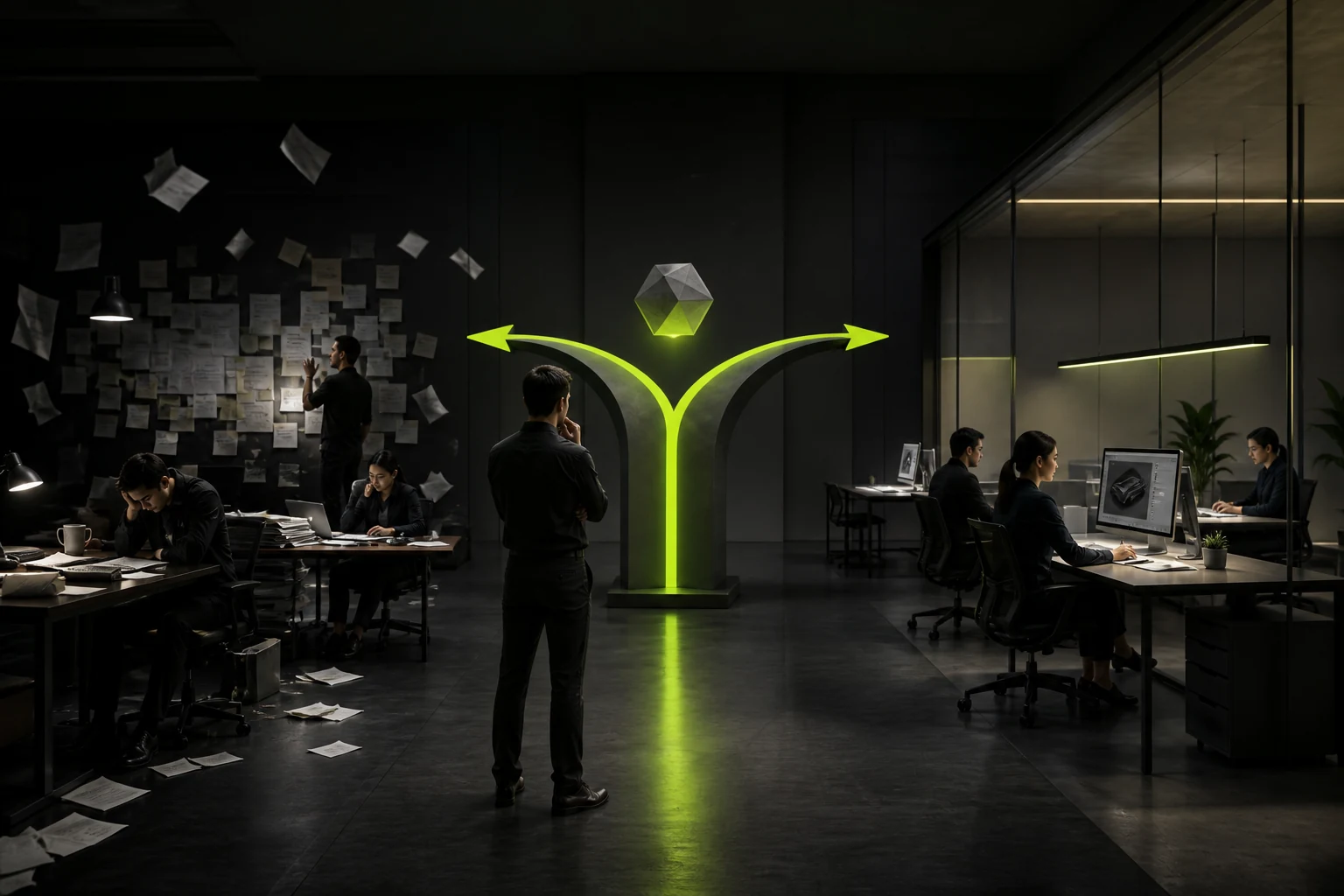
Outsourcing risks include scope disputes, long communication chains, poor knowledge retention, and unclear source files or maintenance. Full-time risks include narrow capabilities, limited peer review, insufficient peak capacity, and being overwhelmed by operational requests.
These risks are not inevitable; each requires an appropriate mechanism designed in advance.
Model | Risk | Mitigation |
|---|---|---|
Outsourced | Unclear boundaries for requirements and revisions | Requirements signoff, staged acceptance, and a change process |
Outsourced | No owner after the project | Source files, design system, reviews, and handoff |
Full-time | Limited professional feedback and growth | External advisors, design reviews, and learning budget |
Full-time | Insufficient peak capacity or specialist skills | Build a trusted vendor pool |
Hybrid | Overlapping responsibilities and unclear decisions | Define the internal owner and external delivery boundaries |
06 A Hybrid Model Often Fits Growing Companies
An internal product or design lead owns business goals, priorities, and long-term standards. External teams handle defined work such as the brand website, major releases, user research, design systems, or motion. Assets and methods return internally after the project.
Hybrid does not mean sending every difficult problem outside. Someone internally must provide information, consolidate feedback, decide, and drive implementation, or even a strong external team will be blocked by conflicting opinions.
07 Answer Six Questions Before Deciding
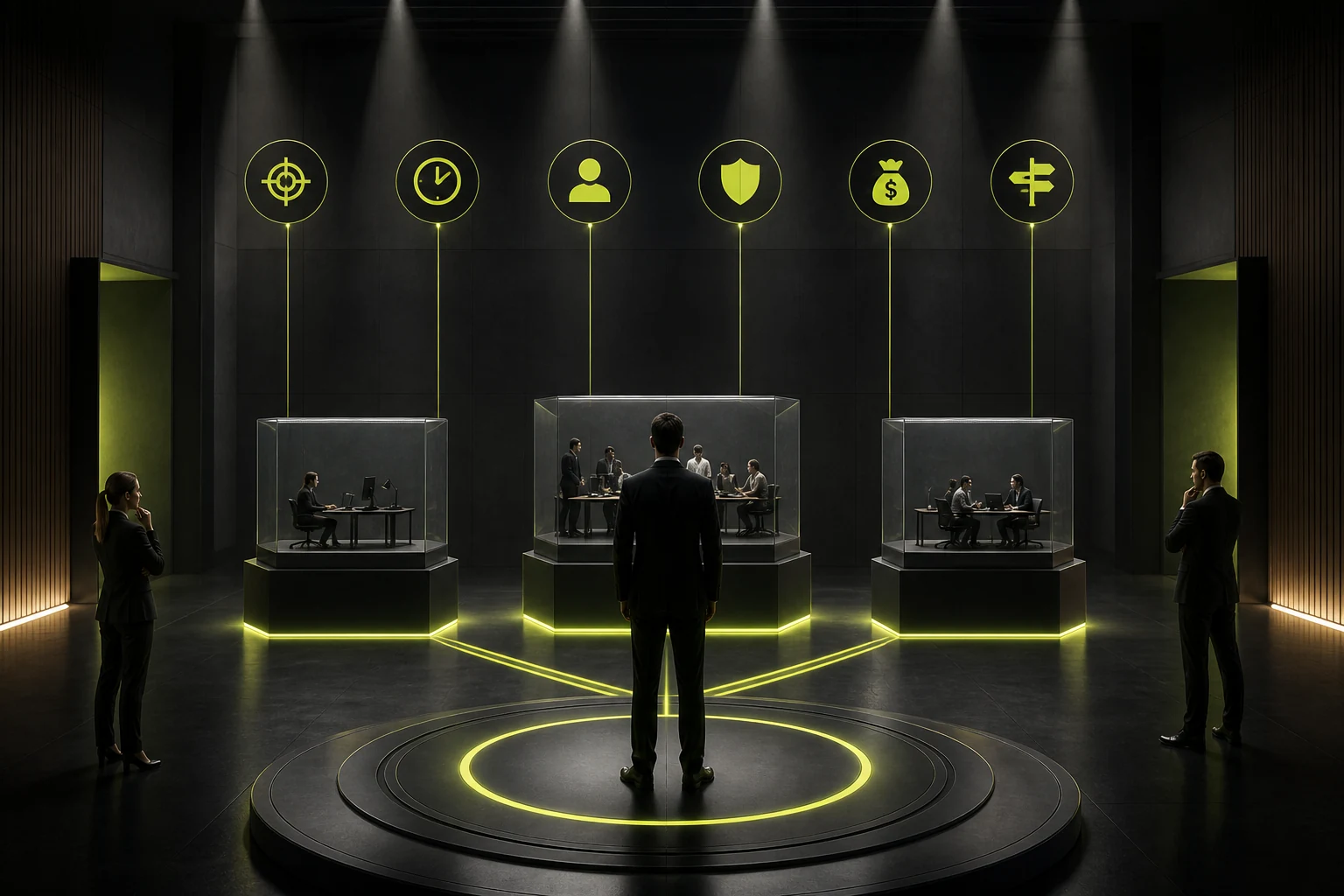
Start with the working model, not which option is cheaper. These questions matter more than a pricing table.
1. Will design demand remain continuous and predictable over the next 12 months?
2. Do business rules require long-term immersion to understand?
3. Can someone internally define problems, consolidate feedback, and approve work?
4. Are multiple specialist capabilities needed temporarily?
5. Who will maintain design assets and knowledge over time?
6. Can the product continue evolving if an employee or vendor leaves?
08 Evaluate More Than a Vendor's Portfolio
When selecting an external team, confirm the people doing the work, project management, research capability, source files, development collaboration, and knowledge transfer. A portfolio shows past results, not who will deliver this project or how.
Do not hire full-time designers on visual work alone. Assess whether candidates understand the business, collaborate with product and engineering, build standards, and handle feedback. Without a clear role and growth path, even excellent people may burn out quickly.
Whichever model you choose, review it after three months or one project: Does demand fit the model? What are the communication cost, delivery quality, and knowledge retention? Then decide whether to grow the internal team or extend the external relationship.
Frequently Asked Questions
Should a startup outsource or hire?
It depends on product stage and iteration frequency. Outsource when direction is unsettled and demand is periodic; build internal capability earlier when iteration is frequent and the business is complex.
Will an outsourced team fail to understand the business?
The risk exists, but a discovery phase, fixed owner, user and business interviews, documentation, and a long-term relationship can reduce it. Highly frequent tacit rules are still better retained internally.
Can one full-time UI designer handle all design?
Usually not. Define the primary responsibility and bring in external support for branding, research, motion, development, or other specialties.
How can hybrid teams avoid duplicate work?
Make the internal team responsible for direction, priorities, and asset governance, and the external team responsible for agreed specialties and deliverables. Use shared design files, reviews, and decision channels.
How long a period should cost comparisons cover?
Compare at least one year of demand and total cost, including recruiting gaps, peaks and valleys, management, and handoff—not only one month's salary or a project quote.
Service | View |
|---|---|
UI/UX design services | |
Product design project consultation | |
Corporate website design and website development |
Need design or website development services?
JVDS Design Studio is a professional design studio focused on digital product experiences and brand identity. We work with businesses in China and overseas that want to strengthen their brand image, improve user experience and grow their business, providing clear, usable UI/UX design, high-quality website design and development, app and mini-program development, and cohesive, distinctive brand identity design.
Working on a B2B system or an app? Share your current screens and key user tasks so we can discuss the design scope.
 Link copied