

A Complete Production Flowchart Is Not Enough: What Evidence Helps Customers Understand Actual Capabilities?
A requirements-to-shipping flowchart explains sequence but cannot prove the company performs every stage. Complete arrows may suggest corresponding equipment, staff and inspection arrangements. Production process capability evidence explains each node’s actual work, sources and remaining external cooperation or confirmation.
Content teams should verify scope before visual design. This is information organization, not industry production standards or process, capacity and quality conclusions from concepts.
Identify general explanations versus actual company work
Companies may explain typical product stages and their own responsibilities. Both may coexist with clear names and scopes. Concept diagrams are not company workflows, and simplified actual-work diagrams must retain essential boundaries.
Define the question: business sequence from requirement to supply, or actual product processes? Consultation, internal design, external cooperation and production may differ in level. Equal-width boxes may imply identical execution and evidence. See How to Design a B2B Solution Page: A Complete Structure from Customer Problems to Sales Leads for related checks.
Owners should explain every node’s object, work and location. Unclear nodes remain pending instead of receiving equipment photos. Check familiar marketing terms too; professional-sounding process names cannot fill gaps.
Identify product-specific scope near diagram titles. Partial workflows on homepages must not become shared across all business. Explain common tasks and separate product differences instead of merging every stage into a mandatory universal route.
Check beginnings and endings. Customer-confirmed designs differ from provider-assisted inputs; work completion differs from customer delivery. Arrows must not bypass unsettled inputs and create automatic-completion promises. See Manufacturing Brand Upgrade: From Product Strength to Global Expression for related checks.
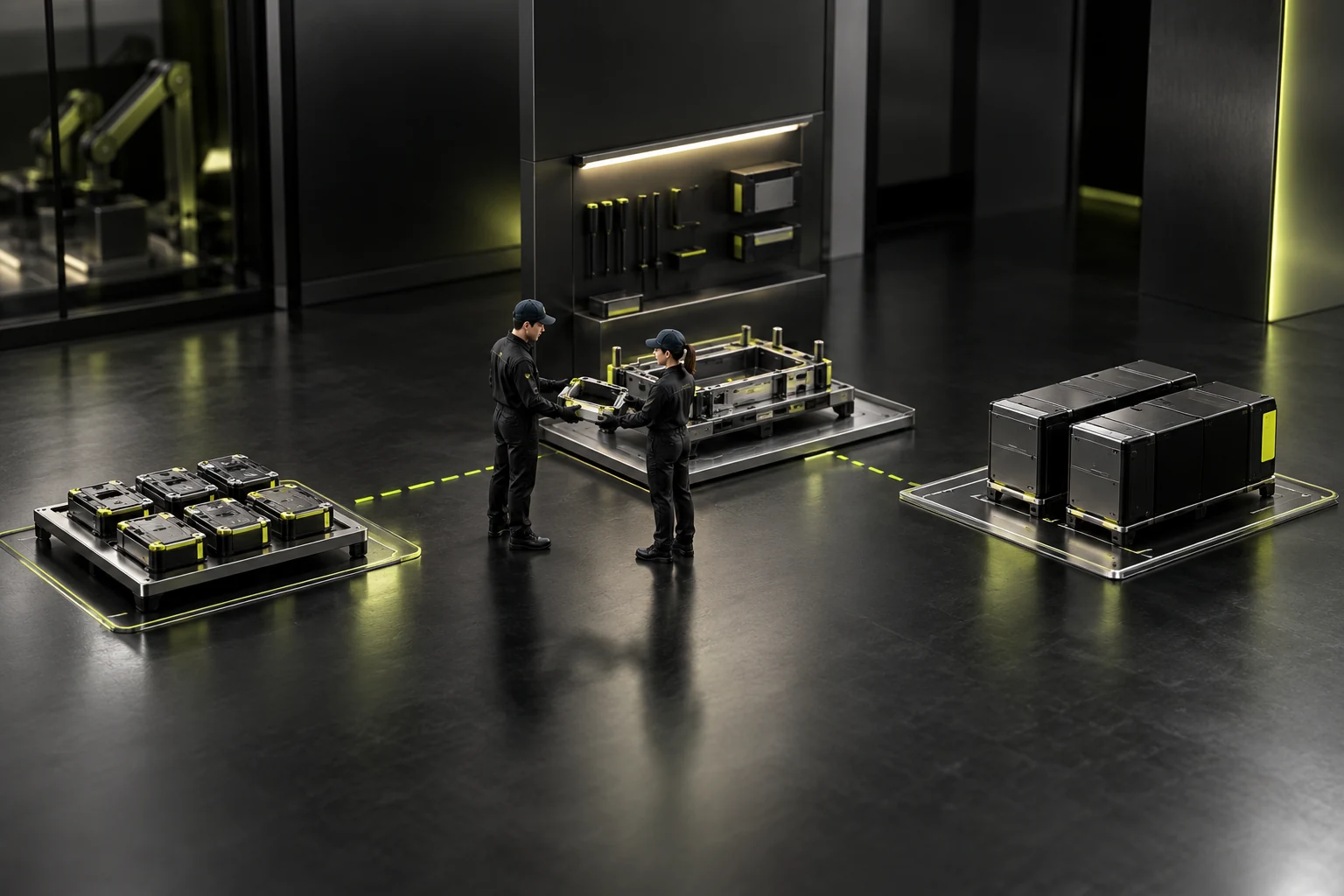
Separate responsibilities at every stage
For each node, identify input providers, executors and result confirmers, not merely file holders. Receiving external documents does not make their described work company-performed.
Existing customer documents may define the starting point. Identify required confirmed inputs and where participation begins. Dependent stages must not appear independently performed, nor should goals alone imply every startup condition is met.
Describe external cooperation accurately: other providers’ tasks, company coordination and disclosure scope. Complete internal supply chains need not be public, but “end-to-end” cannot erase necessary responsibilities.
In a hypothetical arrangement, the company organizes assembly from customer inputs with external supporting work. Retain these relationships. This explains methods without claiming any company actually operates this way or establishing quality and supply capability.
Roles need more than color. Printed or forwarded diagrams may lose distinctions. Preserve names, captions or nearby explanations; visual coding supplements public statements rather than replacing them.
Key nodes need corresponding evidence
Create internal records of node names, objects, roles, existing documents and publishable content. Approved descriptions, site records or object documents may support them; informed owners decide. No universal file type proves every stage.
Evidence must support actual wording. Equipment photos do not establish every product uses the pictured machine; task records do not establish identical processes across a product line. Broader nodes require broader support checks.
Inspection nodes need more than “strict checks.” Owners confirm objects, work and public scope. Websites do not define inspection rules or equate an existing inspection stage with guaranteed results. Professionals handle specific requirements.
For nonpublic documents, approved summaries may explain node tasks and further-information access. Confidentiality does not authorize exaggeration or fabricated record graphics as execution evidence.
Without supporting documents, identify whether nodes are current work, plans or concepts and express each distinctly. Process-design inclusion is not current capability, and publication cannot convert future plans into existing work.

Place variable paths and external conditions appropriately
Actual paths may vary by product, inputs or supply scope. Explain major conditions instead of universalizing a typical route. Current company documents supply conditions, not generic industry impressions.
Some stages apply only to particular tasks, await customer information or involve other parties. Put conditions beside nodes. “Subject to actual conditions” below the diagram does not identify settled and pending portions.
Keep arrow meanings consistent: input transfer, next-stage entry and completed confirmation differ. Designers should not connect everything merely for continuity. Owners check real relationships before layout instead of hiding branches with uninterrupted lines.
Waiting does not necessarily mean failure, and external cooperation does not establish deficient service. Explain inputs and subsequent judgments accurately rather than deleting them for smoothness. Preparation requirements show customers their participation.
Where complex relationships cannot be public, describe a smaller accurate scope with company inputs and outputs. Partial workflows need not appear complete; clear local relationships support assessment better than unproven whole-process imagery.
Review expressions through a complete product task
Use an approved internal task or explicit hypothesis. Check every node from inputs to supplied objects for executor, requirements and evidence. This examines information relationships, not feasibility or capacity.
For the hypothetical assembly task, locate customer inputs, company work and external cooperation. Correct all-in-house labeling, add missing inputs and narrow “delivered” endings where only work completion is shown.
Ask unfamiliar readers to restate responsibilities from the diagram and nearby explanations alone. If they infer independent execution of everything, review headings, arrows and evidence scope. Other-page restrictions should not be required to correct this diagram.
Actual-work owners check facts, marketing checks statements and website staff align titles, body and document entries. Product changes require linked-node reviews, not only new photos with outdated duties.
Production process capability evidence is organized when capability nodes have objects and evidence, roles and conditions are clear, and concepts and plans do not become current work. Diagrams then explain actual participation instead of substituting arrows for facts.

Frequently Asked Questions
Must every process be public?
No. Provide accurate content for tasks and disclosure scope while retaining essential inputs, roles and boundaries. Omitted detail must not turn partial workflows into whole-capability promises.
Can internal process files go directly online?
First distinguish current work from plans and check publication scope. Internal existence does not establish suitability externally or execution readiness for every node.
Can photos alone prove every node?
Their scope depends on objects and context and may not explain roles or complete relationships. Define claims first; owners confirm photographic and other support.
Must external partners be named?
Follow approved disclosure. Accurate relationships can explain without names, but necessary roles cannot disappear into claims of independent execution.
Can one typical workflow cover every product page?
Only with confirmed shared scope. Different inputs and paths need separate explanations. Reused layouts do not establish identical facts across products.
Need design or website development services?
JVDS Design Studio is a professional design studio focused on digital product experiences and brand identity. We work with businesses in China and overseas that want to strengthen their brand image, improve user experience and grow their business, providing clear, usable UI/UX design, high-quality website design and development, app and mini-program development, and cohesive, distinctive brand identity design.
Planning a corporate website, a multilingual site or a redesign? Tell us about your audience, existing website and the work you need.
 Link copied








