After proposal meetings, many companies summarize three candidates in one sentence: "A is the most creative, B is the least expensive, and C is the safest." It sounds clear, but it mixes proposal quality, commercial terms, team capabilities, and the chemistry of the meeting. A decision based only on impressions can select a vendor that presents well but cannot deliver the right result.
When comparing design-company proposals, do not begin with the most attractive visuals. First align the project goals, scope, and review rules, then have every evaluator score independently. The review should have at least two layers: whether the proposal truly solves the problem, and whether the company can reliably implement it. Compare prices only after normalizing scope, rather than making price the sole criterion from the outset.
1. Why Visuals and Total Price Alone Can Mislead
Every company highlights its greatest strength: creative agencies emphasize the concept story, development firms emphasize technology, large agencies emphasize resources and process, and small studios emphasize principal involvement and responsiveness. Without predefined criteria, evaluators can be swayed by the strongest presentation skills.
Total price is also frequently misleading. Quotes of RMB 300,000, RMB 420,000, and RMB 500,000 do not necessarily make the first provider less expensive. Its scope may exclude user research, mobile design, CMS, a design system, testing, or launch support, while a seemingly higher quote may already cover work that will inevitably be required.
- The visuals look strong, but the team cannot explain why they fit target users and the business.
- The concept is complete, but it does not extend to pages, components, content, or development constraints.
- The presentation features flagship company cases, but the actual delivery team did not attend.
- The quote is low, but many critical items say "quoted separately" or are omitted entirely.
- The promised timeline is short, but ignores dependencies involving client feedback, content, integrations, and testing.
2. Align Four Things Before the Review
Fair comparison does not require every company to create the same design; it ensures that all candidates address the same problem. In their 2025 vendor-selection principles, WFA and VoxComm give greater importance to cross-functional alignment, staffing commitments, onboarding, and long-term relationships. For a design project, align at least these four areas.
- Standardized Brief:Use consistent project goals, target users, core scenarios, existing assets, technical constraints, decision-makers, and success criteria.
- Standardized Scope:Specify the number of pages or touchpoints, desktop and mobile coverage, research, copy, development, motion, design system, testing, and launch support.
- Standardized Commercial Terms:Clarify whether the budget includes taxes, third-party costs, licenses, revisions beyond the included rounds, and long-term maintenance.
- Standardized Decision Rules:Define who scores, who has veto authority, whether supplemental materials are allowed, when results will be announced, and how conflicts of interest are handled.
3. Clear Six Red Flags Before Formal Scoring
When any of the following issues arise, request written clarification before selecting a vendor. Unclear intellectual-property rights, data compliance, or delivery-team assignments may warrant automatic disqualification.
Red Flag | How to Assess It |
|---|---|
Unclear Actual Team | The presenters and delivery team differ, and the candidate cannot confirm each person's future allocation. |
Unverifiable Cases | Even within confidentiality obligations, the candidate cannot explain its role, scope, process, and results. |
Unclear Intellectual Property | Rights to source files, fonts, images, templates, plugins, and final deliverables are not defined. |
Major Scope Gaps | Key pages, responsive design, development, testing, or launch support are hidden behind vague terms. |
Clearly Unrealistic Timeline | The schedule ignores dependencies such as feedback, content, integrations, testing, and external review. |
Commercial and Compliance Risk | The vendor refuses basic confidentiality, data-protection, or service agreements, or proposes clearly unbalanced payment terms. |
4. The 100-Point Scorecard: Separate the Proposal from the Vendor
Rate each item from 0 to 5.Weighted score = item rating ÷ 5 × item weight.For example, if an item has a weight of 15 and receives a rating of 4, its weighted score is 12. Add all items for a maximum of 100 points.
A rating of 0 means no response; 1 means slogans only; 3 means generally usable with some evidence; and 5 means clear logic, strong evidence, and a concrete delivery plan. Ratings of 2 and 4 fall between adjacent standards. Do not award a high score for a polished presentation when evidence is missing.
Evaluation Dimension | Weight | Key Evidence |
|---|---|---|
Problem Understanding and Goal Restatement | 15 | Does the proposal identify the real problem rather than repeat the Brief? |
Strategic Logic and Key Tradeoffs | 15 | Do the insights, assumptions, and solution explain one another? |
Solution Fit and Experience Quality | 15 | Does the solution fit users, the brand, content, and business scenarios? |
Evidence, Prototypes, and Feasibility | 12 | Are decisions supported by research, prototypes, technical validation, or cases? |
Actual Team and Expertise | 10 | Do core team members participate in the proposal and specify their commitment? |
Scope, Delivery, and Acceptance | 10 | Are quantities, revision rounds, files, development collaboration, and acceptance criteria clear? |
Pricing Transparency and Commercial Rationale | 10 | Does the price correspond to workload, risk, and exclusions? |
Project Management and Communication | 8 | Are milestones, feedback, risks, and change procedures clear? |
Long-Term Fit and Onboarding Plan | 5 | Does the proposal address knowledge transfer, maintenance, and how both parties will work together? |
The first four criteria primarily evaluate the proposal, for 57 possible points; the last five primarily evaluate the vendor, for 43 possible points. Separating the two prevents one dimension from masking the other.

5. Example Comparison of Proposals A, B, and C
Consider this composite scenario: a company plans to redesign its corporate website and product experience. Company A has the strongest visual impact. Company B submits the lowest quote. Company C is less visually dramatic but offers the most complete explanation of user journeys, content, development, and launch. The scores below only demonstrate the method and do not represent real vendors.
Candidate | Primary Strengths | Primary Risks | Sample Score (Proposal / Vendor / Total) |
|---|---|---|---|
A: Creative Agency | Strong visual concept and presentation | Actual team and development collaboration are unclear; scope has gaps | 48 / 28 / 76 |
B: Low-Cost Execution Team | Low price, short timeline, and many pages | Limited research and validation; many boundaries left for later confirmation | 35 / 26 / 61 |
C: Product-Oriented Studio | Thorough problem definition, user journeys, prototypes, and delivery plan | Restrained visual direction requiring a second round of refinement | 47 / 37 / 84 |
Company A may win an anonymous visual vote, while Company B may win a price-only comparison. Once goals, actual teams, delivery scope, and risk share the same scorecard, Company C is more likely to be the rational choice. This does not mean safety should always outweigh creativity; it means weights must reflect project goals.
6. How to Normalize Different Quotes
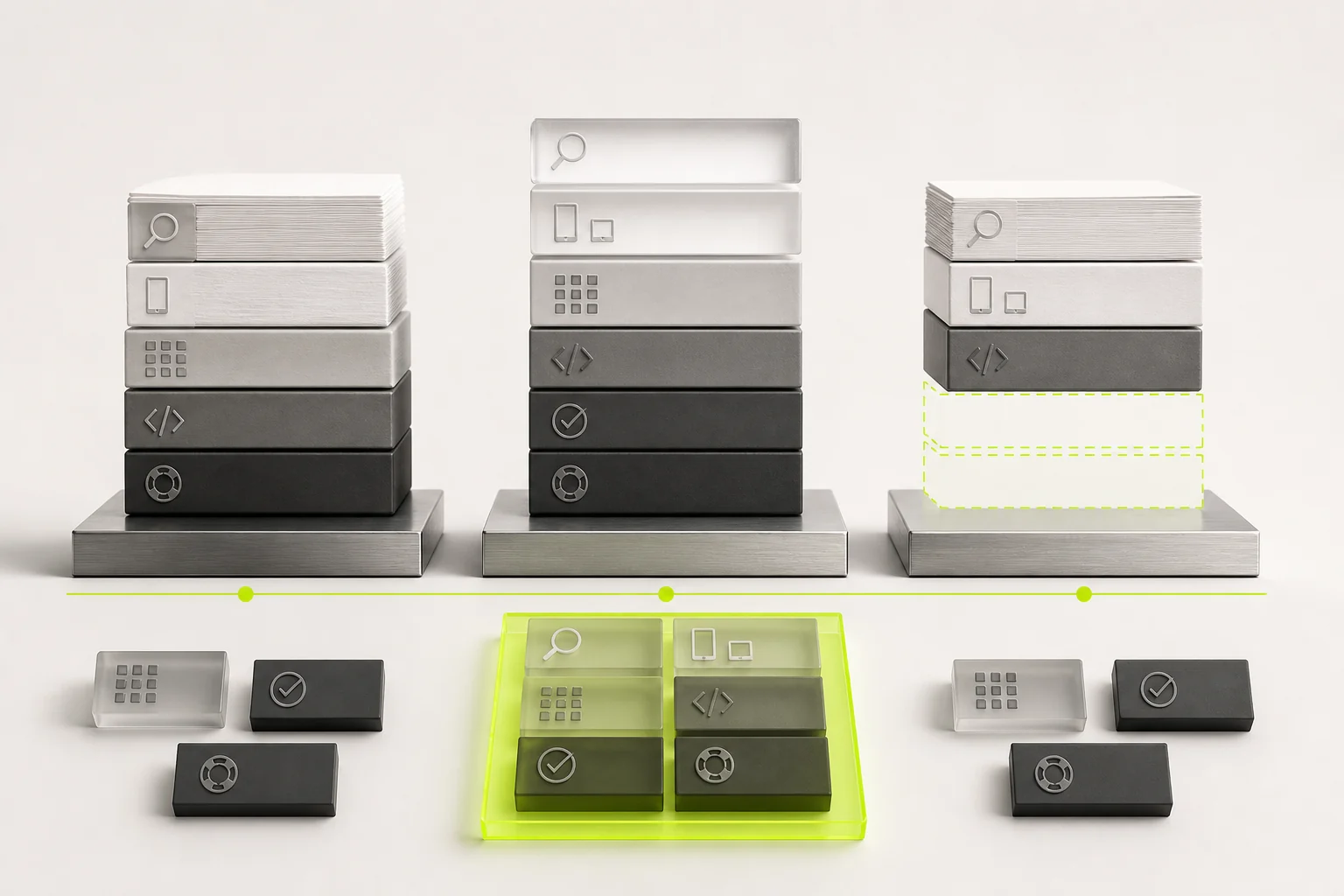
Do not reduce everything to a price per page. Page count is only a surface-level unit; cost is really driven by states, responsive variants, interaction complexity, content preparation, components, third-party integrations, testing, and launch responsibility.
Standardized Item | Required Details |
|---|---|
Research and Requirements | Whether interviews, data analysis, and current-state audits are included, and how many of each |
Information Architecture and Prototypes | Page structure, user flows, prototypes, and usability testing |
Visual and Responsive Design | Home page, internal pages, mobile, empty/error/loading states, and motion |
Development and Technology | Front end, CMS, integrations, deployment, browser compatibility, and performance |
Design System and Assets | Components, Tokens, guidelines, source files, fonts, and image licenses |
Project Management | Meetings, reviews, versions, risk, and change management |
Launch and Maintenance | Testing, launch support, training, warranty period, and ongoing maintenance |
Exclusions | Copywriting, photography, translation, servers, third-party services, and new requirements |
7. Twelve Questions to Ask in the Proposal Meeting
- What do you believe is the real problem we need to solve, and what is out of scope?
- Which decisions come from research or data, and which remain assumptions?
- If the first direction is rejected, what will you change besides simply switching styles?
- How much time will each person presenting today commit after the project begins?
- Show how a similar project evolved from first draft to launch.
- Which technical or content dependencies could affect the schedule?
- Which deliverable formats, quantities, and states are included? Which files are not delivered?
- Who purchases fonts, images, plugins, and templates, and who is responsible for licensing?
- How do you handle scattered feedback, delayed decisions, or changing requirements?
- What are the project acceptance criteria?
- If issues arise after launch, what does the warranty cover and what are the response times?
- If the partnership ends, how will code, designs, accounts, and documentation be transferred?
8. How to Run the Review Meeting
- Before Proposals:Evaluators read the Brief and scoring guidance and confirm what each weight means.
- During Proposals:Record evidence and questions without influencing one another's scores in the room.
- Within 24 Hours After Proposals:Submit independent scores, rationale, and risks.
- Calibration Meeting:Discuss items with the widest scoring gaps before looking at the highest overall score.
- Commercial Review:Normalize scope, taxes, third-party costs, payment, and exit terms.
- Background Verification:Confirm the actual team, delivery scope, and partnership performance.
- Final Decision:Document the reasons for selecting and rejecting candidates, plus conditions that must enter the contract.
Independent scoring matters. If everyone hears the most senior person speak first and then scores, the scorecard merely formalizes a predetermined preference. Scoring should not mechanically replace judgment either: when total scores are close, use the most serious risks, team fit, and onboarding plan to make the final decision.

9. After Selection, the Real Risks Begin
- Confirm each party's project lead, final decision-maker, and day-to-day feedback contact.
- Convert proposal promises into contractual scope, milestones, deliverables, and acceptance criteria.
- Maintain centralized records for requirements, feedback, versions, and changes.
- Provide necessary access to brand assets, data, back-office systems, and technical documentation.
- At the end of the first phase, reassess the problem definition and remaining scope.
10. Frequently Asked Questions
Should we eliminate the company with the highest quote first?
No. Normalize scope first, then determine whether the higher price reflects more work, a more senior team, risk ownership, or simply a premium.
Can creative proposals be reviewed blindly?
You can review visual work anonymously to reduce the influence of brand names and presentation style, but this cannot replace evaluation of teams, process, technology, and commercial terms.
Must the highest-scoring company win?
Not necessarily. Scores expose disagreements and evidence. If an intellectual-property, data, team, or contract red flag exists, pause even when the total score is high.
Can we require a complete proposal for free?
Avoid packaging substantial production work as a free pitch. For complex projects, consider an in-depth case review, capability interviews, a small paid workshop, or a proof of concept.
Conclusion
The most common mistake when comparing design firms is treating the energy of the proposal meeting as evidence of the partnership's quality over the next several months. A sound choice considers problem understanding, strategic logic, solution fit, evidence, the actual team, delivery scope, commercial transparency, and project management.
A scorecard is not intended to disguise subjective judgment as mathematics. It helps different departments express judgment against the same questions. Set red flags first, score independently, and then discuss disagreements and risks. This is generally more reliable than an immediate vote or relying only on a leader's preference.
Ready to Start a Design Project?
First organize your project goals, key pages, delivery timeline, and budget range, thensubmit your requirements to JVDS Design Studio. We will confirm the scope and engagement model before deciding whether to proceed to a formal proposal.
Need design or website development services?
JVDS Design Studio is a professional design studio focused on digital product experiences and brand identity. We work with businesses in China and overseas that want to strengthen their brand image, improve user experience and grow their business, providing clear, usable UI/UX design, high-quality website design and development, app and mini-program development, and cohesive, distinctive brand identity design.
Working on a B2B system or an app? Share your current screens and key user tasks so we can discuss the design scope.
 Link copied