There is no universal answer to whether design and development should go to the same company. One team can reduce coordination on a small corporate website. But for a complex SaaS product that needs deep product design and specialized architecture, giving everything to a vendor with incomplete capabilities can magnify risk.
Do not ask only whether the work sits under one company name. Ask four questions: are design and engineering delivered by genuine core team members; how are handoffs defined; who owns the final outcome; and can your company evaluate the work independently?
01 Four Common Engagement Models
Model | How It Works | Typical Fit |
|---|---|---|
One team owns the full project | One accountable organization manages strategy, UX/UI, front and back-end engineering, testing, and launch | Corporate websites, marketing sites, small platforms, and fast-moving projects |
Design first, then hand off to engineering | Requirements, prototypes, and visual design are completed before hiring a developer or involving the internal team | Experience-led projects, competitive engineering bids, or an undecided technical approach |
External design plus internal engineering | The external team owns the experience and design system; internal engineers implement it | Companies with established product and engineering teams |
Prime contractor plus specialists | One project lead coordinates branding, design, engineering, security, and other experts | Large redesigns, complex integrations, multiple markets, and highly regulated work |
02 The Real Advantages of One Team
- Requirements, design, and technical feasibility are evaluated together, reducing late discoveries that a design cannot be implemented.
- Visual and interaction defects have clear ownership rather than creating finger-pointing.
- Design-system components and front-end implementation are easier to align.
- One project lead coordinates the schedule, reducing meetings and handoff overhead.
- Post-launch bugs, styling, and content issues can move through one workflow.
These advantages exist only when the team genuinely has both design and engineering capability. Some “full-service” companies outsource development ad hoc and lack an established designer-engineer workflow. The client sees one contract, but several hidden subcontracting layers create even more information loss.
03 The Real Advantages of Separate Specialists
- You can choose the strongest design and technical experts independently rather than accept one team’s capability ceiling.
- Design can be completed first so multiple developers quote against the same scope.
- Internal engineering retains the core codebase and architecture while external specialists focus on experience and visual quality.
- The design team can conduct independent design QA during implementation, creating a useful quality check.
- Specialized teams can handle security, data, algorithms, and complex integrations.
The cost of separation is more than two vendor quotes. It includes product management, interface documentation, meetings, version control, design QA, and acceptance. Without one owner coordinating the whole system, two excellent teams can still produce a fragmented product.
04 Comparison Across Six Dimensions
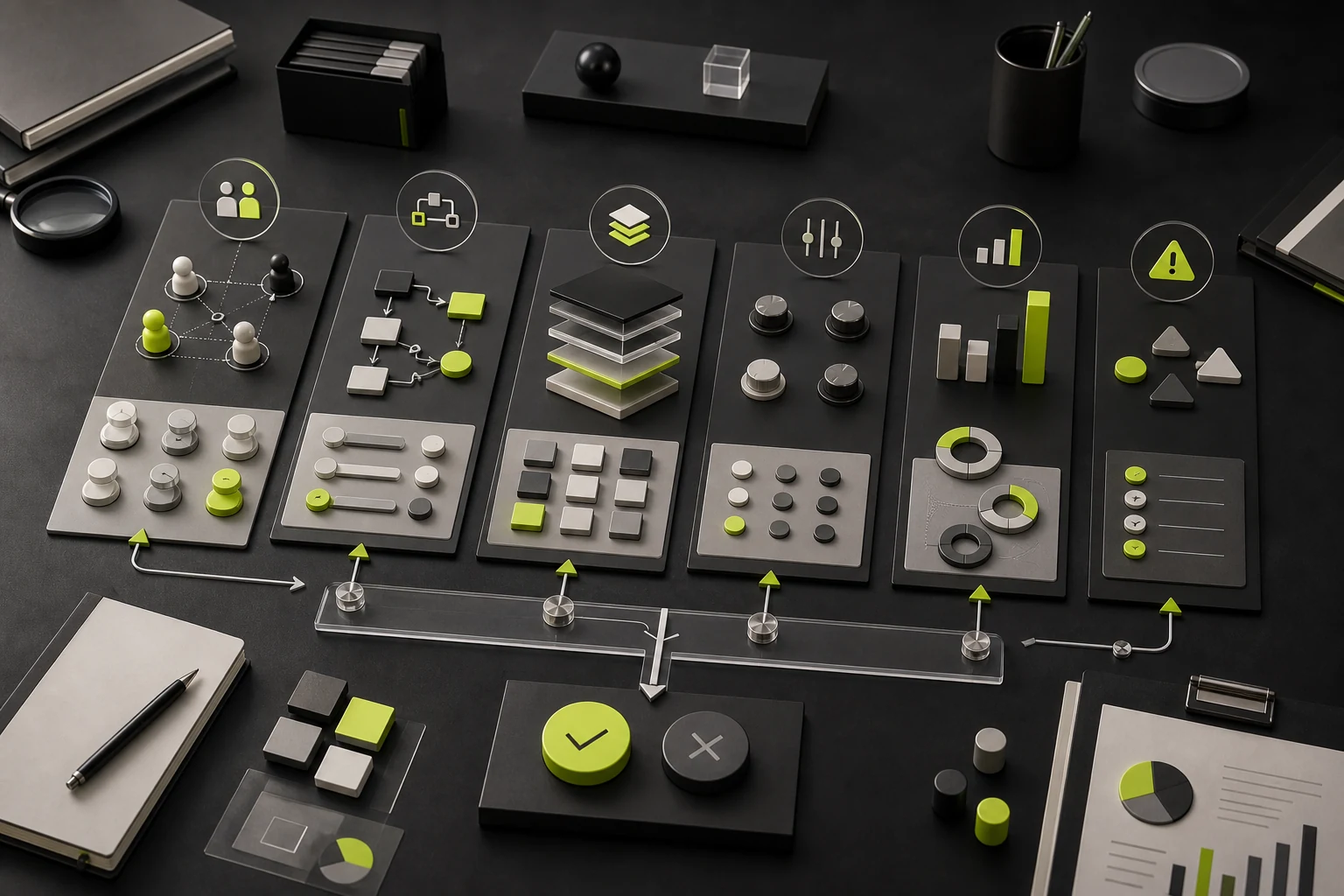
Dimension | One Integrated Team | Separate Design and Engineering |
|---|---|---|
Communication efficiency | Usually higher, with fast internal coordination | Depends on the client or project manager owning the interface |
Design fidelity | Accountability is concentrated, but front-end capability must be verified | The design team can review independently if budget and access are provided |
Technical depth | Limited by the integrated team’s technical range | Specialized architecture, security, and data teams can be selected |
Pricing transparency | One total is easy to understand, though internal effort may be opaque | Line items are clear, but management and handoff costs are easily missed |
Change response | Fast internal coordination but stronger vendor lock-in | Partners can be adjusted independently, but both must assess change impact |
Checks and balances | One organization is accountable, but independent review is weaker | Teams can review each other, but may also shift blame |
05 Projects Better Suited to One Team
- □ The project centers on informational pages, content management, and standard forms.
- □ Design and development need to move together, and the company has no dedicated product manager.
- □ The delivery window is short and scope is relatively stable.
- □ The company wants one organization accountable for launch and maintenance.
- □ The vendor has actual designers, front-end and back-end engineers, and testers—not temporary subcontractors.
06 Projects Better Suited to Separate Specialists
- □ The company has a mature engineering organization and architecture but needs outside UX and visual expertise.
- □ The product includes complex permissions, algorithms, real-time data, payments, security, or industry-system integrations.
- □ Experience quality is a competitive advantage and requires substantial research and product definition.
- □ The company has a product manager, technical lead, and clear acceptance process.
- □ Multiple developers must bid against one defined design scope.
07 The Handoff Package Required for Separate Teams
When design and engineering are separate, static mockups are not enough. The handoff package should include a screen matrix, flow diagrams, responsive rules, component specifications, a state matrix, data examples, motion guidance, font and image licensing, API dependencies, exported assets, and design-QA procedures. Complex products also need a role-permission matrix and exception-state documentation.
Handoff Asset | Problem It Solves |
|---|---|
Screen and state matrix | Prevents implementation of only the happy path while missing empty, error, loading, permission, and extreme states |
Design system and component rules | Aligns spacing, color, type, component states, and responsive behavior |
Interaction and motion guidance | Defines triggers, duration, feedback, and reduced-motion behavior |
Content and data examples | Tests long text, large numbers, no-data states, and multilingual content |
QA and defect workflow | Defines who files issues, severity, correction time, and closure criteria |
08 An Integrated Team Still Needs Internal Checks
Integration does not eliminate acceptance. The company should approve design independently, require a test environment during engineering, and run content, functionality, SEO, performance, and security checks before launch. Ideally, the vendor has distinct design, technical, and project leads rather than one person promising, delivering, and accepting the same work.
09 Decision Matrix
Your Situation | Recommended Model | Why |
|---|---|---|
A 10–30 page corporate website with no internal technical team | One integrated team | Communication, fidelity, and launch accountability are concentrated |
A SaaS redesign with an established engineering team | External design plus internal engineering | Preserves technical continuity while adding specialist UX capability |
A complex platform being created from scratch before the business is fully defined | Product definition and design first, then choose the development model | Avoids premature lock-in to a technical solution and quote |
A multilingual brand website with creative motion | Integrated team or prime contractor plus creative development | Brand, performance, and cross-device implementation must be controlled together |
Payments, healthcare, or another high-security system | Specialist teams under unified project management | Security, compliance, and business architecture require dedicated expertise |
10 Eight Questions to Ask Before Signing
- Who owns design and engineering, and can you meet the actual team members?
- Will any work be outsourced or subcontracted, and how are scope and accountability defined?
- Is the technical approach assessed before design, or only after the design is complete?
- Who owns product requirements, content, APIs, and third-party resources?
- How is design fidelity accepted, and does the scope include design QA?
- Who delivers source files, source code, accounts, and deployment documentation?
- Who handles post-launch bugs, environment issues, and new requirements?
- Can another team take over cleanly if the engagement ends?
Frequently Asked Questions
Is one company always less expensive?
No. It may reduce management and handoff costs, but design, engineering, testing, and operations work still exists. Compare complete scope and total cost of ownership, not the number of contracts.
Does designing before development waste time?
No, if the project includes early technical review and scope control. Completing core flows and design first can reduce rework. The issue is not sequence but whether real technical constraints inform design.
If we have internal engineers, do we still need an external design team?
External designers can add independent methods and quality when the internal team lacks user research, complex workflow design, design systems, or brand expression. Engineering can remain internal.
How can we tell whether an integrated team actually subcontracts?
Ask to meet the assigned members, review similar work, understand code-design collaboration and project management, and require disclosure of material subcontracting and responsibilities in the contract.
When design and development are separate, who owns the outcome?
The company must appoint one program owner and define interfaces, deliverables, QA, and defect closure in both contracts. Otherwise, an accountability gap is inevitable.
Service | View |
|---|---|
Website design and development | |
UI/UX design services | |
Project inquiry |
Need design or website development services?
JVDS Design Studio is a professional design studio focused on digital product experiences and brand identity. We work with businesses in China and overseas that want to strengthen their brand image, improve user experience and grow their business, providing clear, usable UI/UX design, high-quality website design and development, app and mini-program development, and cohesive, distinctive brand identity design.
Working on a B2B system or an app? Share your current screens and key user tasks so we can discuss the design scope.
 Link copied